
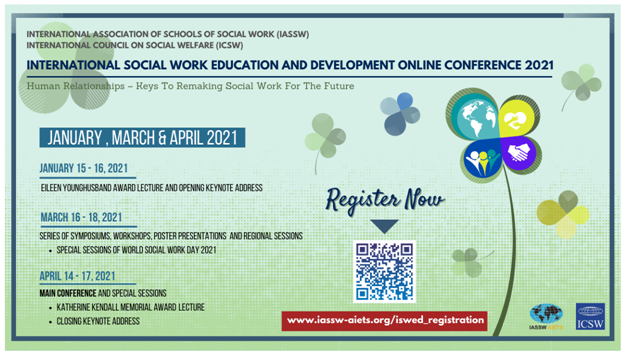
Members of the MIGREC team – Nevenka Žegarac and Natalija Perišić, together with Katarina Lončarević– participated at the conference “Human Relationships – Keys to Remaking Social Work for the Future” organised by the International Association of Schools of Social Work and International Council on Social Welfare with presentation “Co-production of Knowledge for the Protection of Children Affected by Migration: Curriculum Development”, on April 16, 2021.
The Conference was structured around 5 topics: Promoting human relationships, global context and sustainable development; Sustainable Development Goals (SDGs) in fostering human relationships; Social policy to enhance human relationships; Gender and minority issues, and social inclusion and integration; and Challenges and capacities of Social Work Education and Research in promoting human relationships.
Prof. Žegarac pointed to numerous challenges brought up for social work practice by a migrant “crisis”. She pointed that in Serbia, for a relatively short period, social workers had to acquire new knowledge and develop specific competencies to response to the needs of migrant families with children, especially unaccompanied migrant children. Her presentation focused on designing and trial of the process of co-creation of knowledge in the development of social work curriculum in order to equip students and professionals for responding to new vulnerabilities of children in the context of migration.
In order to create a curriculum integrating existing and emerging knowledge and comparative experience, a specific process was designed and implemented. It involved national and international perspectives, achievements and shortcomings from different policies and experiences, social work practice wisdom, gender studies experts’ knowledge focusing on gender based violence (GBV), cultural differences and gender positioning of children in the context of migration. It comprised of review and evaluation of training courses for professionals during the migrant “crisis”; analysis of curricula for social work with migrant children from universities worldwide; mapping and systematization of experiences of social services operating in the migration field in Serbia; and a series of consultations with frontline practitioners, program managers, volunteers, policy makers and migrant children. The main points of the process were framing, designing and leading ethical and inclusive consultations and diligent documenting of the process and its outcomes. Finally, it included verification, reflection and critical review of experiences.