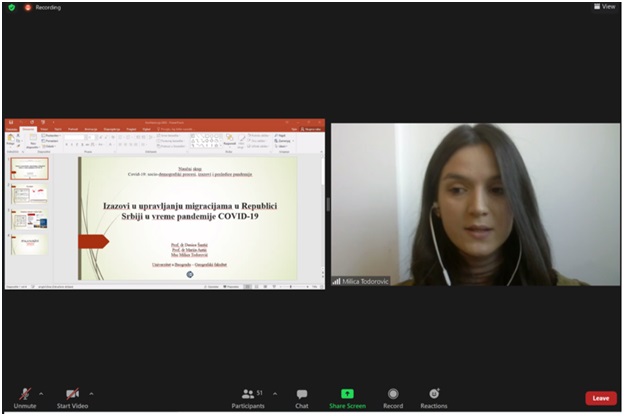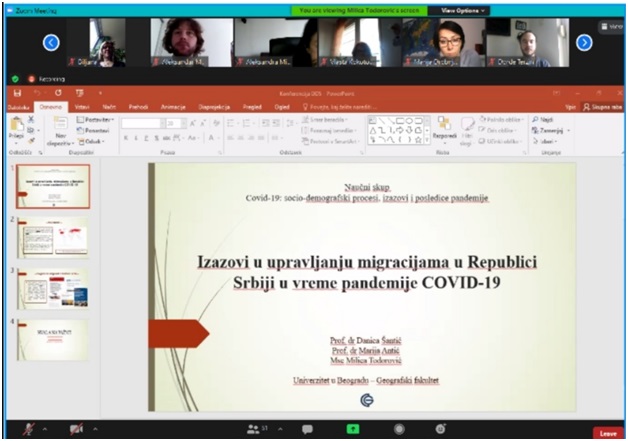
Members of the MIGREC team – Danica Šantić, Marija Antić and Milica Todorović – participated at the conference “COVID-19: socio-demographic processes, challenges and consequences of the pandemic” organized by the Demographic Association of Serbia and the Center for Demographic Research of the Institute of Social Sciences with presentation “Challenges in Migration Management in the Republic of Serbia during the COVID-19 pandemic”, on March 25, 2021.
The academic conference was devoted to analyses of effects and consequences of the COVID-19 pandemic on demographic, social and migration processes. More than 50 prominent researchers from the Republic of Serbia and other countries of the region who treat population topics from various aspects took part in the conference. Although long-term consequences of the pandemic for population, society and migration are still uncertain, the participants on this occasion exchanged the so-far obtained research results, opinions and attitudes in the actual pandemic context. The papers were organized in three sessions: mortality due to the corona virus pandemic, COVID-19 and population and social groups and COVID-19 – migration and labour market.
Prof. Danica Šantić, Prof. Marija Antić and Milica Todorović, MSc, presented their research results within the third session: COVID-19 – migration and labour market. Their research put accent on the challenges the Republic of Serbia faced with in management of return migration flows and irregular migration in the aftermath of introduced state of emergency. The authors pointed out that mass return migration flows in the Republic of Serbia in that period made a huge challenge for the state which policy moved between “don’t stay/don’t leave” discourses. On the other hand, it was stressed that irregular migrants during the state of emergency faced with particularly unfavorable circumstances having in mind the limitation of movement from the admission centres and high level of their stigmatization. The conclusion is that in this period the migration-related policies were carried out in accordance with the conditions of global health and economic crises, which the Republic of Serbia was not exempted from.