
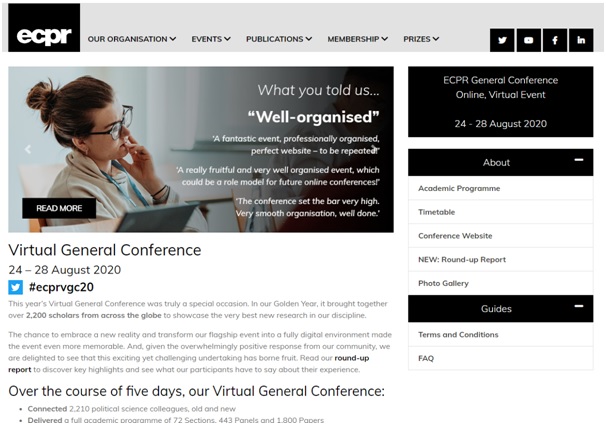
MIGREC team member, Biljana Đorđević, had a successful online presentation titled “Confronting the Progressive Dilemma, Rethinking Inclusive Solidarity” on 27/8/2020, at the 14th ECPR Virtual General Conference that took place online between 24-28 August 2020 (#ecprvgc20).
ECPR (The European Consortium for Political Research), that has celebrated its 50th anniversary in 2020, is the leading scholarly society for political scientists in Europe that through its events, publications and research groups, foster scholarly collaboration across borders. ECPR organizes many events, but the general conference, alongside ECPR’s joint sessions, is considered as the key event in the agendas of most political scientists in Europe.
Due to the COVID-19 crisis the 2020 ECPR General Conference successfully transitioned from a planned live event at the University of Innsbruck into the virtual conference. The organizers made the online conference the best they could, scheduling a programme that could fit different time zones and devising an excellent website for the general conference with friendly and helpful interface. The programme has been rich as always at the ECPR general conferences consisting of 43 sections with 443 panels and 1804 papers, several roundtables, exhibitions, and discussions with top editors, but also regular meetings of the ECPR Standing Groups. Finally, the virtual conference also included interesting social program such as floor, standing and seating exercises before each conference’s day, and recipes for ice creams and other delights at the end of conference.
The presentation of the MIGREC member was part of the Section “International Migration Policies and Politics: Current Challenges and Opportunities”, supported by the ECPR Standing Group on Migration and Ethnicity, and was realized on the panel “Transnational Social Protection: Countries’ Policies and Migrants’ Practices in the EU”, held on 27/8/2020, 13:30 – 15:15(BST), using the Zoom meeting platform. Biljana Đorđević presented results of her study about lack of integration policy in Serbia and the need for translation of the so-called progressive dilemma (bounded solidarity vs. Diversity) into a different context of a transit/transitional country such as Serbia. The panel included 4 paper presentations, and had two panel discussants. It provided a tremendous opportunity for exchange of research results and ideas, as well as different disciplinary perspectives such as the ones coming from political theory and social policy.