
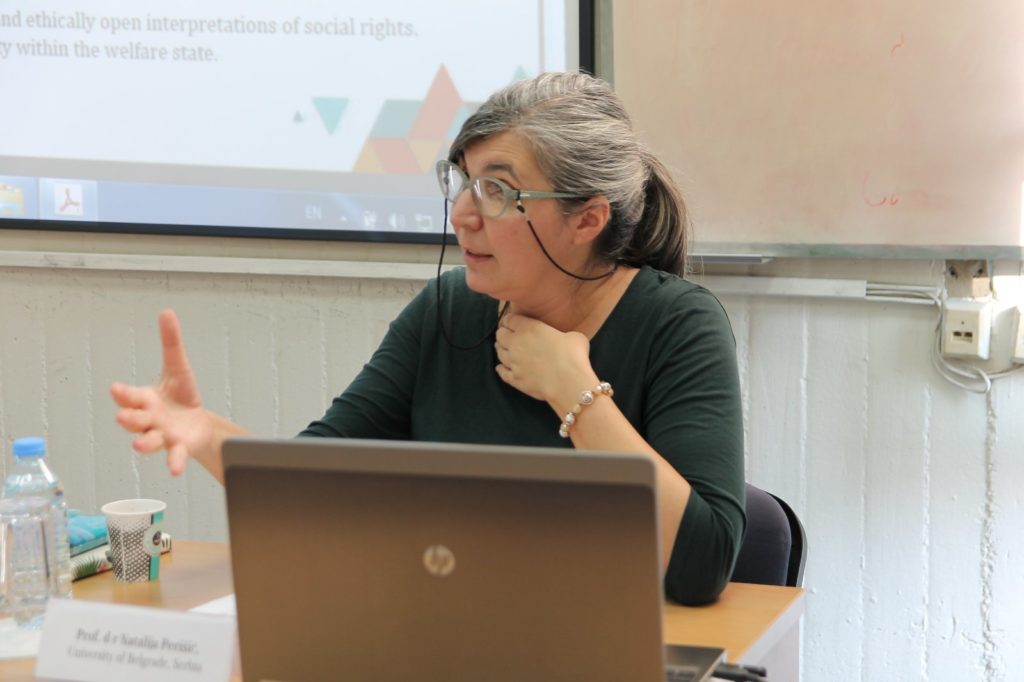
Professor Natalija Perišić, a member of MIGREC, had a presentation on providing social services to migrants in transit through Serbia at the Institute of Social Policy and Social Work of the Faculty of Philosophy in Skopje, North Macedonia, on November 27th 2019.
The presentation was a part of the First Regional Week of CESPASWON held from November 25th to 29th, 2019 in Skopje, North Macedonia, financed under CEEPUS Programme. CESPASWON – the Central European Social Policy and Social Work Network, is a network of academics and researchers in the field of social policy and social work. The main idea behind CESPASWON is to build upon previously existing cooperation practices in the region (i.e. among ex-Yugoslav Republics) and extend the links with new partners (i.e. Austria, Czech Republic) in order to establish academic alliances among universities that will nurture, promote and advance the regional social work and social policy research and teaching.
Prof. Perišić’s presentation focused on the migration situation in Serbia and the provision of welfare to irregular migrants. The theoretical framework of the presentation started from the concept of social rights and its consequences to limited welfare of irregular migrants in general. The central part of the presentation was the analysis of social services provided by the public and the civil sector stakeholders. The services under scrutiny were those aimed at the provision of basic support – accommodation, food and clothing, cash benefits, but also psychological support, legal advice and advocacy, child protection, educational support and capacity building. In the conclusion, the main challenges the sectors are facing were identified, along with obstacles to their improvement. Some of the challenges are at the macro level and are attributed to the overall decline of the national welfare state. Those relating mainly to the lack of cooperation mechanisms between the public and the civil sector are meso-level challenges. Finally, micro-level challenges refer to the capacities of the sectors per se.