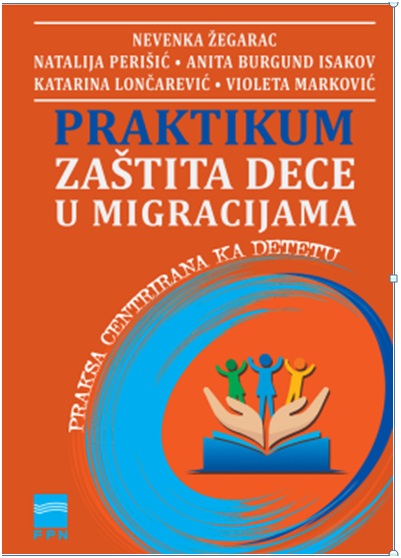
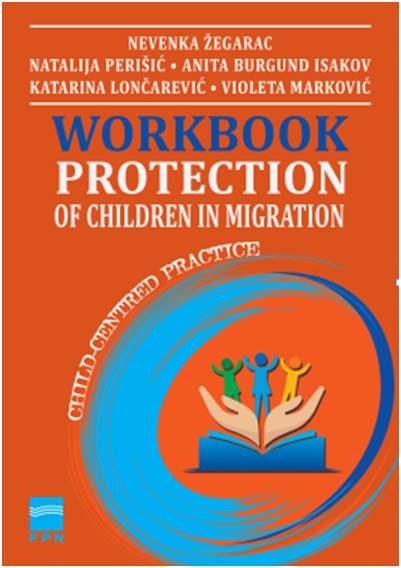
Prof. Dr. Nevenka Žegarac, prof. dr. Natalija Perišić, doc. dr. Anita Burgund Isakov, doc. dr. Katarina Lončerević i asist. MA Violeta Marković published a textbook „ Protection of Children in Migration: A Rights-Based Approach” in Serbian and a workbook „ Protection of Children in Migration: A Rights-Based Approach: Child-Centred Practice” in Serbian and English.
The “Protection of Children in Migration: A Rights-Based Approach” textbook was developed under the Co-creating Knowledge and Building Expertise for Protection of Children Affected by Migration – Curriculum Development project which was implemented by the Belgrade University’s Faculty of Political Science with the support of the UNICEF in Serbia and the United States Bureau of Population, Refugees and Migration. The original results and deliverables of the project were followed by financial support from the European Union Health Programme “Strengthening refugee and migrant children’s health status in Southern and South-Eastern Europe”, for the development of the textbook and workbook which combine experiences gained during multi-layered, co-creative work with decision makers, practitioners, students, researchers and analysts.
Comprehensive research and consulting activities were implemented during the project. Focus groups and interviews were organised with 40 policy and decision makers, as well as practitioners from the public and civil sectors from different parts of Serbia, who are involved in the protection of children in migration. Special attention was paid to consultations with unaccompanied migrant children and children traveling with their families. We consulted with 14 boys and girls from Afghanistan, Iran, Pakistan and Syria, who agreed to talk to the research team (along with other necessary parental and guardian consents), in a way that was carefully and professionally designed, ethically rigorous, highly participatory and child-friendly.
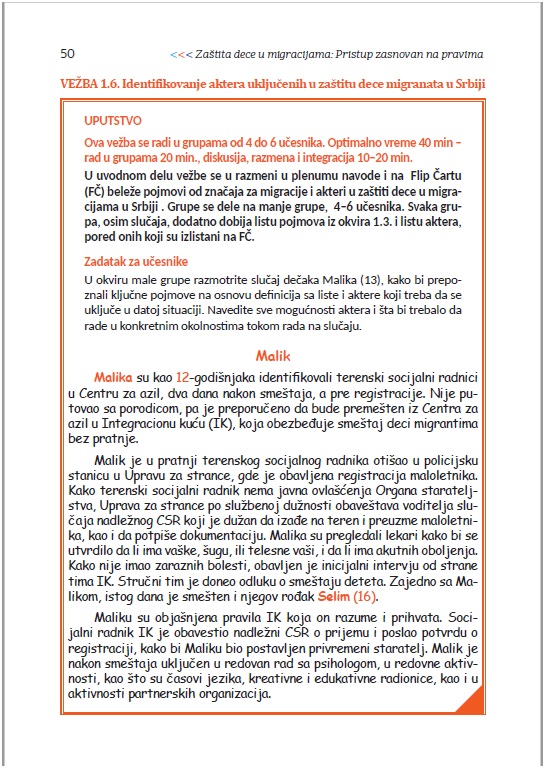
Based on the knowledge gained and material collected, the curriculum was designed in accordance with the university education standards, followed by a Continuing professional education (CPE) programme for practitioners. The programme was piloted in the 2019/20 school year and was delivered for the second time in 2020/21. In addition to students from different faculties, the classes also included a number of practitioners. Based on the experiences from the two teaching cycles, a Protection of Children in Migration textbook was developed, with the accompanying workbook. The textbook comprises ten chapters, thematic units which cover various areas of protection of migrant and unaccompanied children. It is intended for students of the Faculty of Political Sciences and other social sciences and humanities faculties, but also for decision makers and practitioners in the field of child protection, as well as those who come into contact with migrant and unaccompanied children in their work. Each chapter has defined learning objectives, it elaborates and explains theoretical concepts and practical approaches in the multidisciplinary field of child protection in migration, and includes appropriate practical exercises which are a prerequisite for experiential learning, recommendations for further reading and a list of key terms.
Chapter one elaborates the characteristics, trends and actors, provides an overview and analysis of the migration process, with a focus on children in migration. Although migrations have existed in all societies in the past, they belong to those processes that essentially affect the reshaping of modern societies and policies. The first chapter introduces and explains the basic concepts, notions and theories of migration, provides an understanding of the characteristics of modern trends in migration, as well as related knowledge in political science, to help understand migration flows involving children, and the role of actors in protecting children in migration, in the national and international framework.
Chapter two covers the rights-based approach and the child protection framework, where the theoretical, legal and practical component of the child rights-based approach is elaborated. The chapter offers a critical review of the understanding of childhood as a social phenomenon and the rights of the child. In the context of migration, the application of the four fundamental principles of the UN Convention on the Rights of the Child is crucial, from the point of view of the extent to which a child-centred policy, strategy, measure, programme or activity is fair, inclusive and participatory. The social work practice approaches that have strong implications and significance for working with children in migration and their families are also presented. These include, among others, the empowerment approach, strength-based practice, eco-systemic thinking, anti-subjugation, anti-oppressive and anti-discriminatory social work practices. These concepts, with the application of the principles of culturally competent practice, operationalize the practical application of the child rights-based approach.
Chapter three provides an overview of the framework for understanding migrations, “push and pull factors”, standards for child protection in humanitarian crises, and in particular the Global Minimum Standards for the Child Protection in Humanitarian Action. These contents are aimed at understanding the factors that encourage migration, learning about the relevant concepts and interpretation of the specifics of child protection in emergency and crisis situations. This lays the foundation for the application of these standards in practice and the ability to recognize and assess the degree to which child protection standards in emergencies and crises have been applied.
Chapter four deals with the identification of children in migration and the organization of initial interventions. This chapter deals with the process of identification of children in migration, theoretical and practical aspects of opening of the case management process, rules for interviewing children, initial procedure for establishing and determining the best interests of the child and standards for establishing child-friendly spaces. This provides an understanding, comparison and interpretation of standards and procedures for organizing child-friendly reception and assistance and identifying the best interests of the child in migration in Serbia, Europe and international practice, during identification and initial interventions.
Chapter five discusses the risks and resilience of children in migration. This chapter deals with contemporary knowledge about trauma and the impact of traumatic experience, as a knowledge base for the development of child protection systems in migration. This knowledge, together with the previously discussed rights, standards and principles of child protection, is placed in the context of risk and vulnerability assessment together with protective factors, which includes the child’s right to participate and consultations with children which encourage their resilience and capacity. Special attention is paid to the care of professionals and the importance of self-care, as well as debriefing techniques. The learning objectives in this chapter are aimed at learning and understanding the main concepts, ideas and theories about trauma as well as at interpreting and applying an assessment approach based on recognizing trauma and encouraging resilience, as well as understanding the importance of self-care.
Chapter six analyses the issues of gender and vulnerability, where the essential concepts and gender theories are elaborated, as well as the system of gender roles as a system of inequality that exists in every society and culture. The issues of understanding gender and vulnerability on the example of women and children on the move are explained here, with the elaboration of the issues of vulnerability of children (boys and girls) in migration and specific gender characteristics of vulnerability of unaccompanied and separated children. As it is almost impossible in practice to separate the issues of gender and vulnerability and gender-based violence in migration, this chapter offers a coherent framework for understanding the problems and building gender-sensitive interventions.
Chapter seven deals with child abuse in migration. Here, the risks to which children are exposed at different stages of migration processes and specific forms and manifestations of violence against children in migration are considered in order to understand and recognize the characteristic types of abuse. The main forms of violence faced by children in migration are presented, and the phenomena of smuggling, child trafficking and abuse of child labour in migration are comprehensively discussed.
Chapter eight deals with gender-based violence and its characteristics for children in migration. Migrations are presented as a gender process. The system of gender roles is presented as a system based on inequalities and discrimination that lead to violence, while the patriarchy itself changes as societies change, but it is present in various forms everywhere, including the migrants’ countries of origin. The learning objectives are aimed at understanding and interpreting the concepts and analysing the manifestations of gender-based violence in migration, as well as relevant international and national conventions, and at understanding the survivor-based approach to gender-based violence.
Chapter nine explains and elaborates the case management guidelines for children in migration. This chapter discusses case management standards in migrant children in national and transnational aspects, the child rights and procedures during the age assessment process, elaborates the decision-making process on the best interests of the child and interprets the good practice standards in protection of children in migration with interpreters and cultural mediators. The learning objectives are, inter alia, aimed at identifying, explaining and resolving ethical dilemmas in the case management process when working with children in a migration situation and interpreting the child’s rights and procedural guarantees in procedures for assessing and determining the best interests of the child in migration (including age assessment).
Chapter ten deals with the conceptual, legal, organizational challenges and challenges present in the social work practice relative to the alternative care of migrant children. This chapter deals with topics related to services intended for families of migrants with children, issues of guardianship, particularities of alternative care forms for unaccompanied and separated children. Long-term solutions for these children in accordance with international legal guarantees are also systematically presented: voluntary return to the country of origin, integration in the country of destination, relocation to a third country, family reunification in the country of origin, destination or a third country and international adoption.