MIGREC at the conference „Innovation and Resilience“

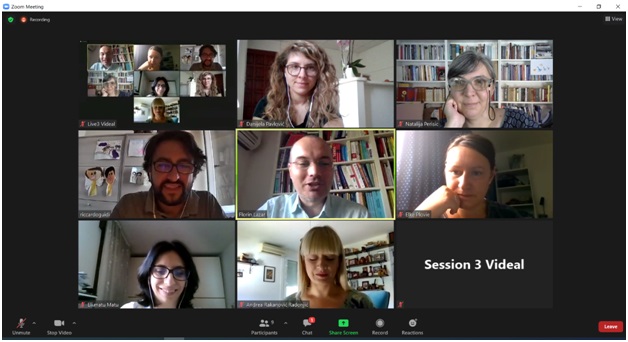
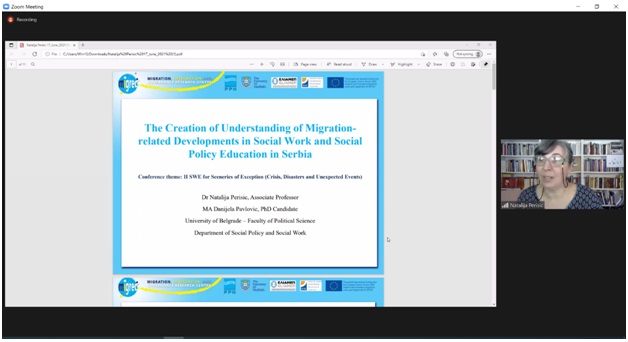
Members of the MIGREC team, Natalija Perišić and Danijela Pavlović, participated on June 17, 2021 at the conference „Innovation and Resilience: Preparedness of Social Work Education in Uncertain Times“ organized by the European Association of Schools of Social Work and the University of Tallinn with presentation „The Creation of Understanding of Migration-related Developments in Social Work and Social Policy Education in Serbia“.

The conference was structures around six topics:

  1. Lifespan and Social Work in an Era of Innovation
  2. Social Work Education for Sceneries of Exception (Crises, Disasters and Unexpected Events)
  3. Post-Traumatic Approaches in Social Work
  4. Innovative Social Work Teaching Practices Involving Service Users
  5. Innovative Skills for Social Work Practice with Distressed Groups: Migrants, Refugees, War and Conflict Victims and Health Crises Victims
  6. Social Work Ethics in Times of Uncertainty: Balancing Innovation and Tradition

Professor Perišić showed that the influence of various kinds of migration on Serbian society was deep. She pointed out that the migration trends were diverse: forced and voluntary, regular and irregular, internal and external. It is reasonable to expect that all this will be enhanced in near future. As the result, she mentioned the necessity for stronger support to vulnerable population and the need for reshaping the developmental concept of the society. Her presentation focused on the impact of the MIGREC project on emerging understanding of migration-related developments in education for social work and social policy in Serbia.

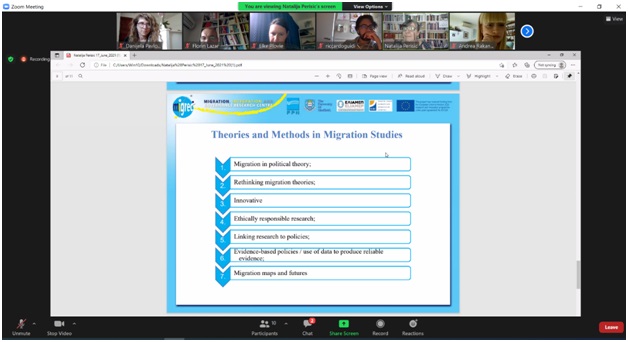
In addition, the presentation contained the thematic fields of the project: integration of migrants, migration governance, development and migration nexus, theories and methods in migration studies and knowledge, discourses and representation of migrants. Prof. Perišić pointed out that researching each of the thematic fields and putting them within the research centre to be developed within the project would lead to development of theoretical, practical and political knowledge and understanding of importance for education in social work and social policy at the doctoral studies level.
MIGREC at the conference „Innovation and Resilience“ Read More »
IMISCOE PhD Network Presentation Series

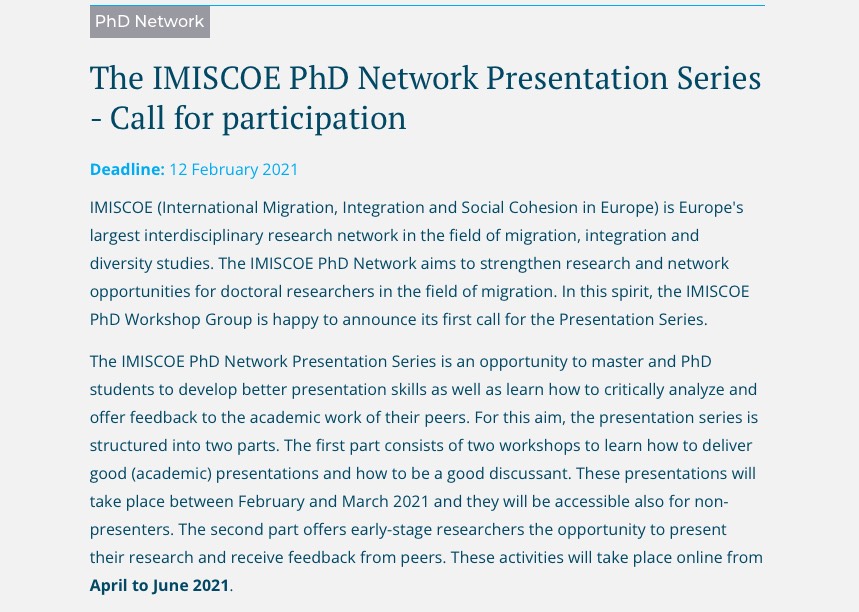
A member of the MIGREC team participated in the IMISCOE PhD Presentation Series which was held during April, May and June 2021. This Presentation series was focused on PhD students and young researchers, with the aim to develop better presentation skills as well as learn how to critically analyze and offer feedback to the academic work of their peers. The presentation series was structured in two parts: it started with lectures for PhD candidates and young researchers on how to deliver good presentations and how to participate in the discussion; the second part consisted of young researchers and PhD students presenting their work and getting feedback from their peers and professors.

Violeta Marković, PhD candidate at the Faculty of Political Science of the University of Belgrade participated in both parts of this Presentation series. In the second part she presented her PhD proposal on June 15, 2021 as part of the Children and Migration series. Her presentation was on Child labor among unaccompanied and separated children refugees and migrants on their journey from countries of origin to the Republic of Serbia. She pointed out that the risk of children being exposed to child labour abuse is high, given that migration itself contains all those elements that are otherwise defined as risks of children being exposed to this type of abuse: poverty, irregular school attendance, parental unemployment, etc. Based on three theoretical approaches: child protection, advocacy and resilience, the objective of this research was to determine and systematize the characteristics of child labour and the experiences of unaccompanied and separated children with protection systems mandated to protect children from child labour on their journey from the country of origin to the Republic of Serbia and in Serbia. She pointed out that in order to do this, she will be using a mixed research design, combining qualitative and quantitative research methods. The data in the research will be collected in two ways – through a questionnaire with social protection professionals and focus groups and interviews with stakeholders and unaccompanied and separated children and youth. She is hoping for the research to have a wider impact on society, practice of protection of children and that new scientific knowledge will provide basis to improve the protection of children affected by child labour abuse, especially in transit countries.

IMISCOE PhD Network Presentation Series Read More »
MIGREC at the IMISCOE PhD Network Presentation Series

Member of the MIGREC team, Danijela Pavlović, participated at the IMISCOE PhD Network Presentation Series aimed at enhancing research capacities for PhD candidates in the field of migration. IMISCOE offers to PhD candidates an opportunity to develop better presentation skills and learn how to critically analyze academic work of their colleagues and give appropriate feedback. To that end, the presentation series was structured in two parts. The first part consisted of two workshops with lectures for PhD candidates – how to deliver good (academic) presentations and how to be successful in discussion. The second part encompassed researchers’ presentations in early phase, giving them an opportunity to present their work and get feedback from their colleagues.

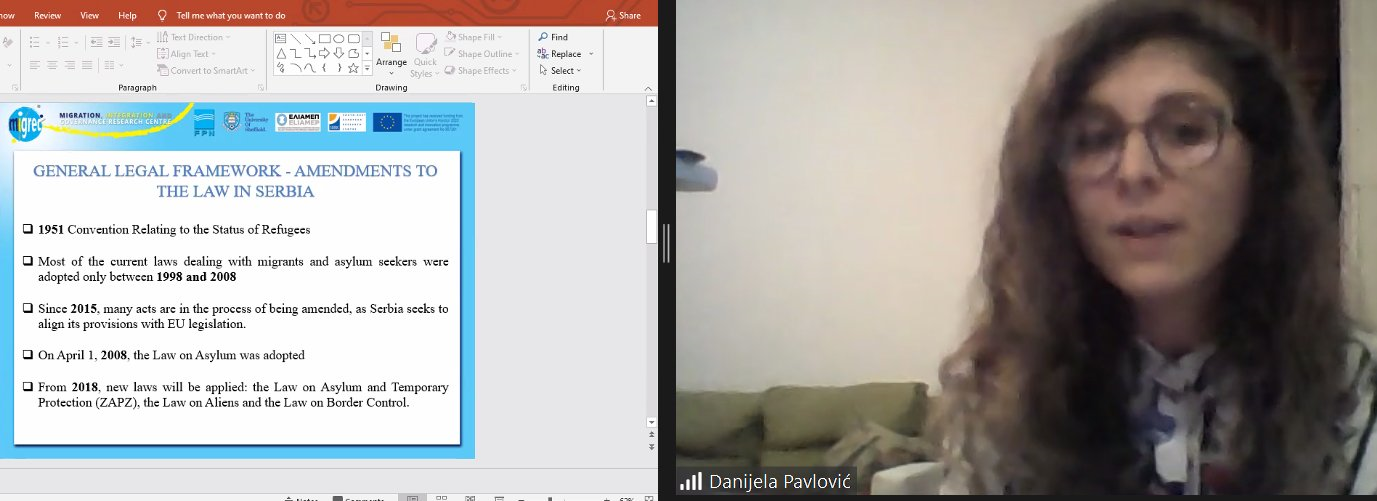
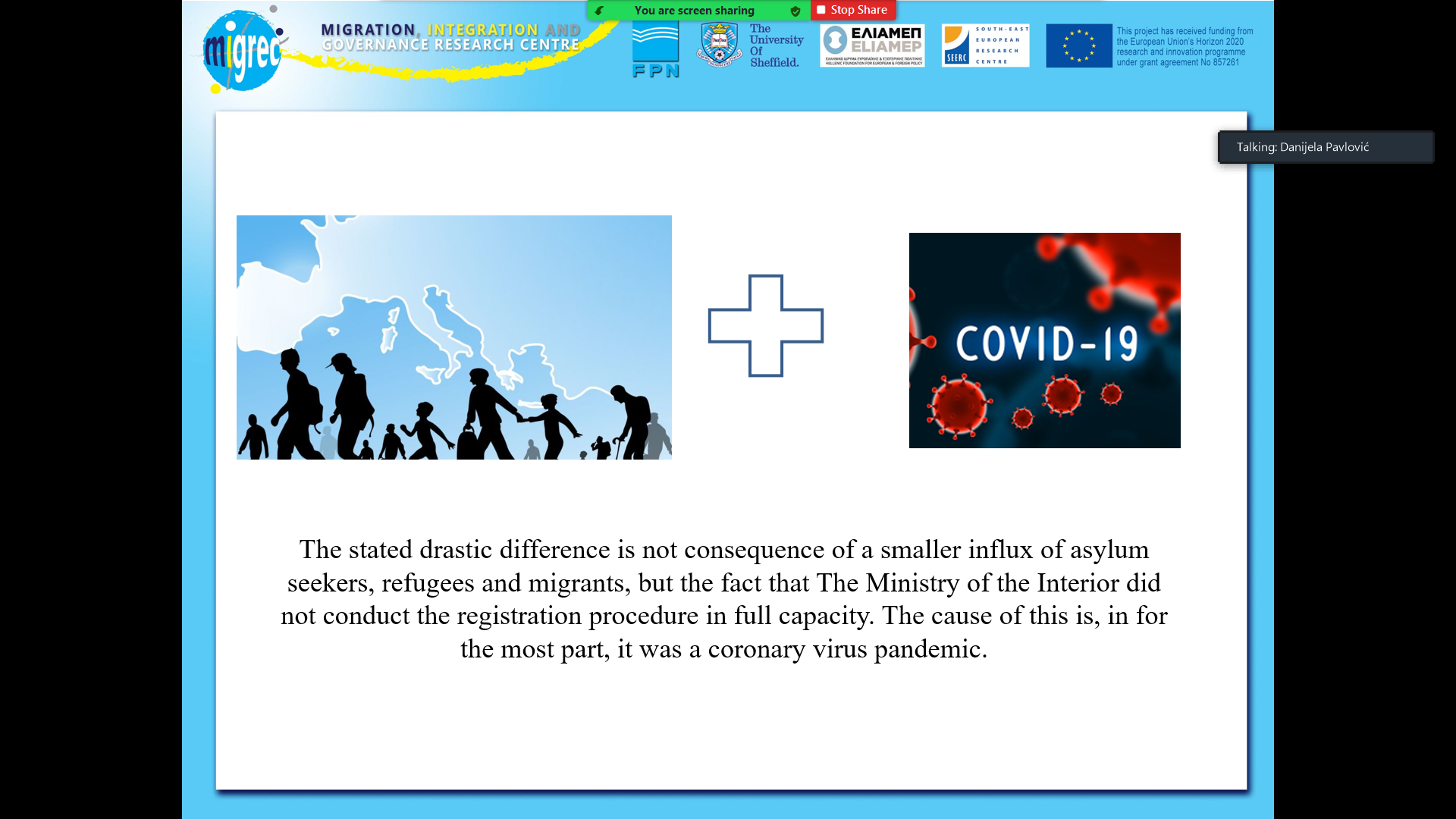
Danijela Pavlović spoke on May 20, 2021 about the asylum policy and challenges to and responses of the system in the Republic of Serbia, with a reference to the challenges brought by the Covid-19 pandemic. She pointed out that on their routes migrates were meeting national systems which did not recognize their requests and rights, thus making them an invisible and extremely vulnerable category of population. She stressed that the asylum system in Serbia started to be implemented on April 1, 2008, with the adoption of the Law on Asylum, but that prior to the this moment Serbia neither had a functional system of asylum protection nor the state authorities had experience in this field. Danijela Pavlović spoke about the most important novelties in 2018 and the adoption and implementation of new laws: Law on Asylum and Temporary Protection, Law on Foreigners and Law on Border. She pointed out that persons with approved right to asylum enjoy legal guarantees for rights to accommodation, stay, health care, freedom of movement, education, legal and social aid, access to labour market and assistance in integration. The adoption of new law indeed created prerequisites for improvement of asylum system in Serbia; however, on the other hand there are problems which professionals keep facing with in working with migrants. The author said that registration of asylum seeker and acceptance of new asylum requests had been stopped during the pandemic. In this period, migrant policies were carried out in accordance with conditions of global health and economic crises, which the Republic of Serbia was no exception whatsoever.


MIGREC at the IMISCOE PhD Network Presentation Series Read More »
MIGREC at the Conference of Global Campus South East Europe

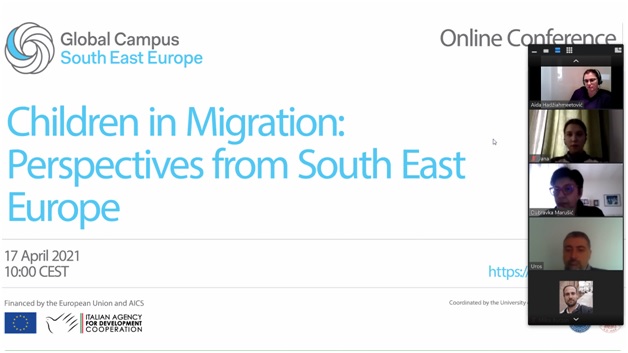
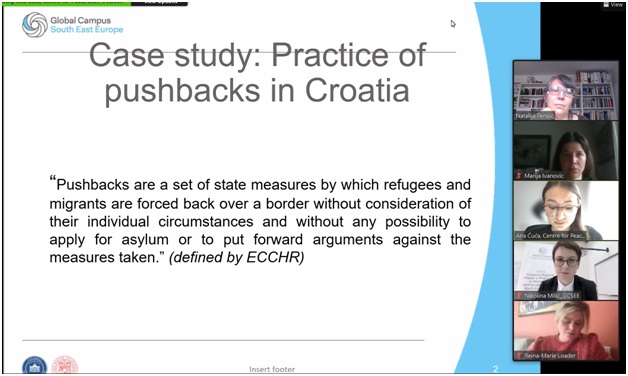
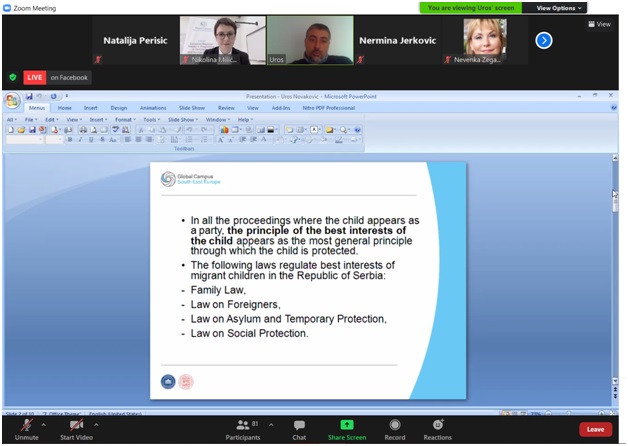
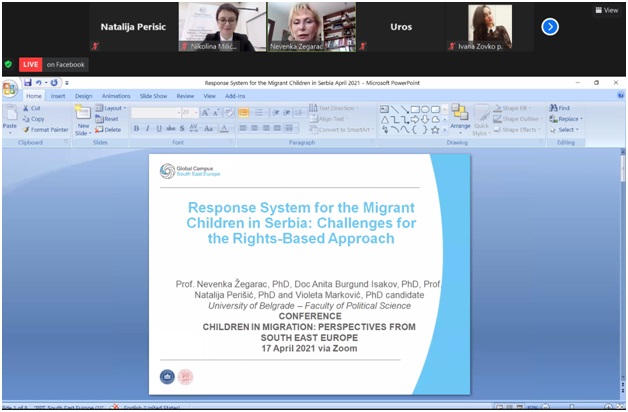
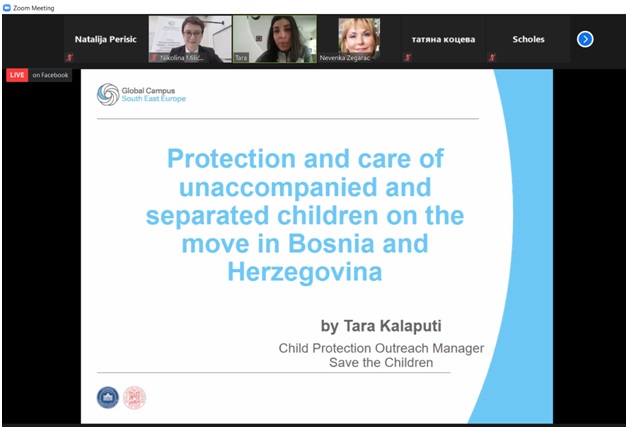
Members of the MIGREC team – Nevenka Žegarac, Anita Burgund, Natalija Perišić and Violeta Marković – participated at the conference “Children in Migration: Perspectives from South East Europe” organised by the Global Campus South East Europe / European Regional Master Programme in Democracy and Human Rights in South East Europe, the University of Sarajevo and the University of Bologna with presentation “Response System for the Migrant Children in Serbia: Challenges for the Rights-Based Approach”, on April 17, 2021.

The conference was a part of the two-year-long project ‘Children in migration in South East Europe’ which aims to strengthen education, research, training, network-building, and advocacy for the rights of migrant and refugee children in South East Europe by producing high-quality research on the topic and disseminating knowledge among students, academia, relevant stakeholders, and the wider public.

The conference focused on presenting and discussing the preliminary findings of research done by 16 researchers from five countries of South East Europe. Research encompasses different issues around children in migration through the region, from identification and arbitrariness of age assessment to guardianship and access to education and integration. The objectives of the conference were to contribute to a mutual understanding of the highest child rights standards enshrined in international and regional mechanisms, as well as to create a space for knowledge exchange between relevant stakeholders, experts and practitioners working directly with children in migration in different countries of South East Europe.

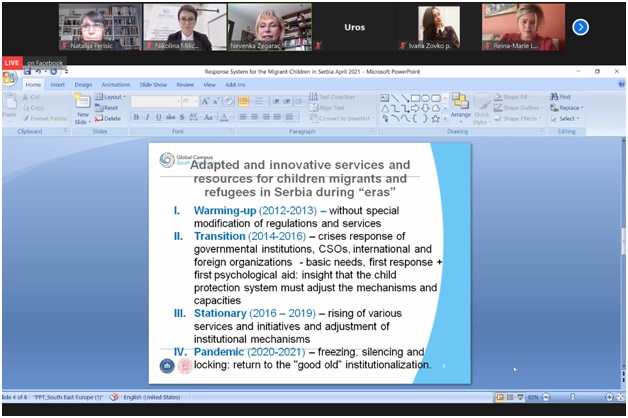
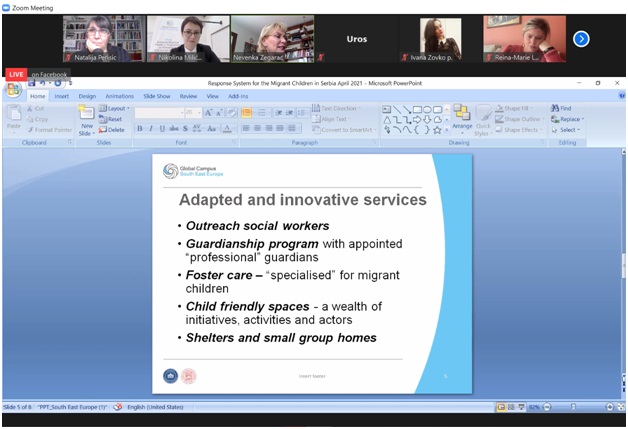
Prof. Žegarac presented her contribution on the challenges for the rights-based approach to migrant children in Serbia. She argued in favour of shifting national responses from migration perspective to child rights-based perspective and the importance of child participation and agency, gender sensitivity and diversity.  The development of child centered services in the national context passed different stages to result in some adapted and some innovative services for migrant children. Prof. Žegarac presented in more detail outreach social workers, guardianship programme, foster care, child friendly spaces, as well as shelters and small group homes for migrant children. Finally, she reflected on the availability, accessibility, acceptability and quality of child-rights response. The main conclusions are an unprecedented dose of adaptability and resilience, openness to innovation and the need to respect the rights-based approach, flexible usage of resources, and quick shifts to changing situations, but also the lack of institutional memory of the response system, as well as the absence of an authentic approach based on the rights of children.


MIGREC at the Conference of Global Campus South East Europe Read More »
MIGREC at the Conference of International Association of Schools of Social Work and International Council on Social Welfare

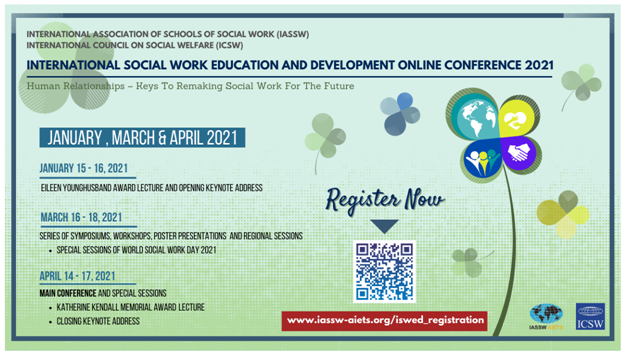
Members of the MIGREC team – Nevenka Žegarac and Natalija Perišić, together with Katarina Lončarević– participated at the conference “Human Relationships – Keys to Remaking Social Work for the Future” organised by the International Association of Schools of Social Work and International Council on Social Welfare with presentation “Co-production of Knowledge for the Protection of Children Affected by Migration: Curriculum Development”, on April 16, 2021.

The Conference was structured around 5 topics: Promoting human relationships, global context and sustainable development; Sustainable Development Goals (SDGs) in fostering human relationships; Social policy to enhance human relationships; Gender and minority issues, and social inclusion and integration; and Challenges and capacities of Social Work Education and Research in promoting human relationships.

Prof. Žegarac pointed to numerous challenges brought up for social work practice by a migrant “crisis”. She pointed that in Serbia, for a relatively short period, social workers had to acquire new knowledge and develop specific competencies to response to the needs of migrant families with children, especially unaccompanied migrant children. Her presentation focused on designing and trial of the process of co-creation of knowledge in the development of social work curriculum in order to equip students and professionals for responding to new vulnerabilities of children in the context of migration.

In order to create a curriculum integrating existing and emerging knowledge and comparative experience, a specific process was designed and implemented. It involved national and international perspectives, achievements and shortcomings from different policies and experiences, social work practice wisdom, gender studies experts’ knowledge focusing on gender based violence (GBV), cultural differences and gender positioning of children in the context of migration. It comprised of review and evaluation of training courses for professionals during the migrant “crisis”; analysis of curricula for social work with migrant children from universities worldwide; mapping and systematization of experiences of social services operating in the migration field in Serbia; and a series of consultations with frontline practitioners, program managers, volunteers, policy makers and migrant children. The main points of the process were framing, designing and leading ethical and inclusive consultations and diligent documenting of the process and its outcomes. Finally, it included verification, reflection and critical review of experiences.


MIGREC at the Conference of International Association of Schools of Social Work and International Council on Social Welfare Read More »
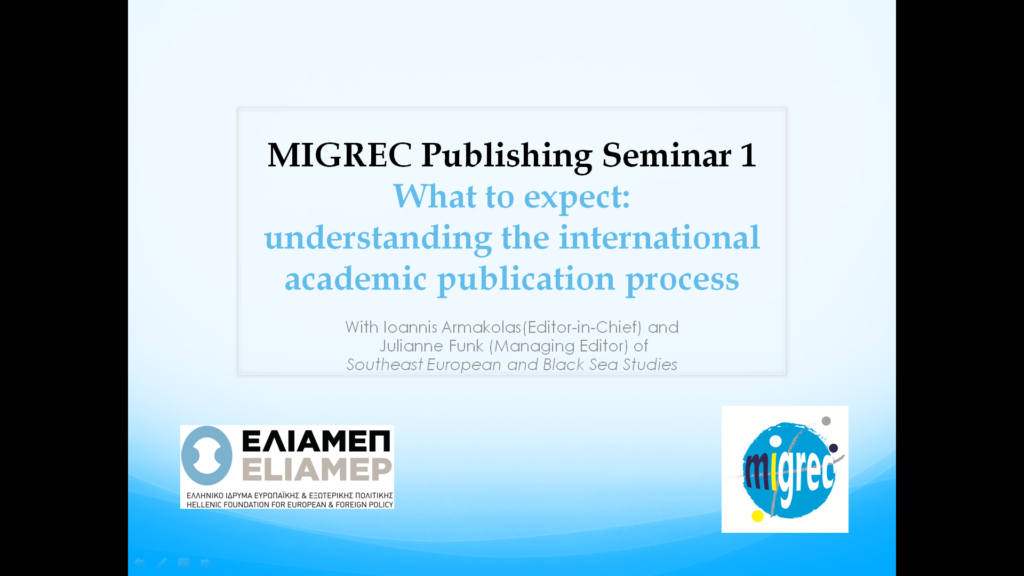
MIGREC’s first Publishing Seminar a success

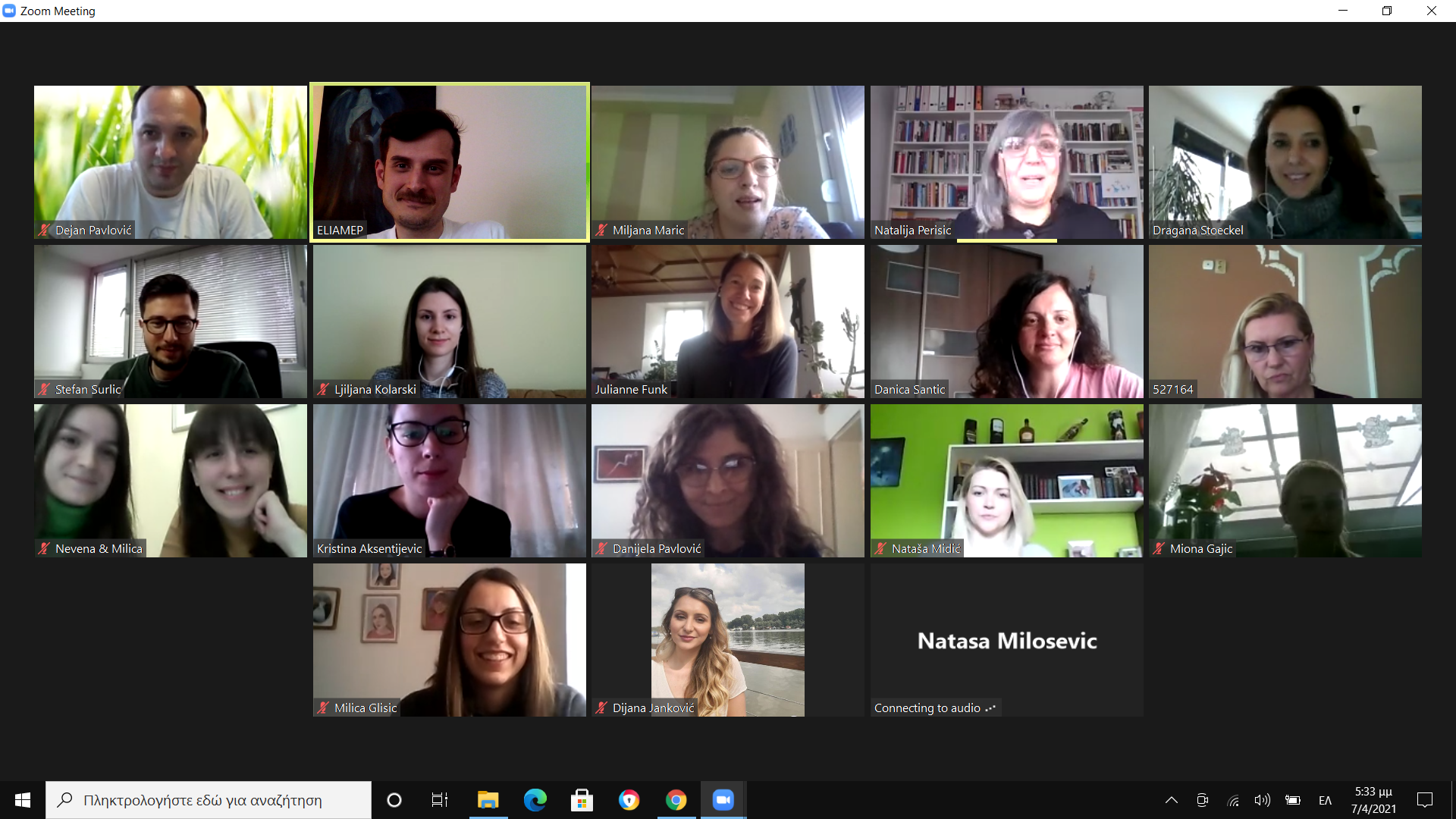
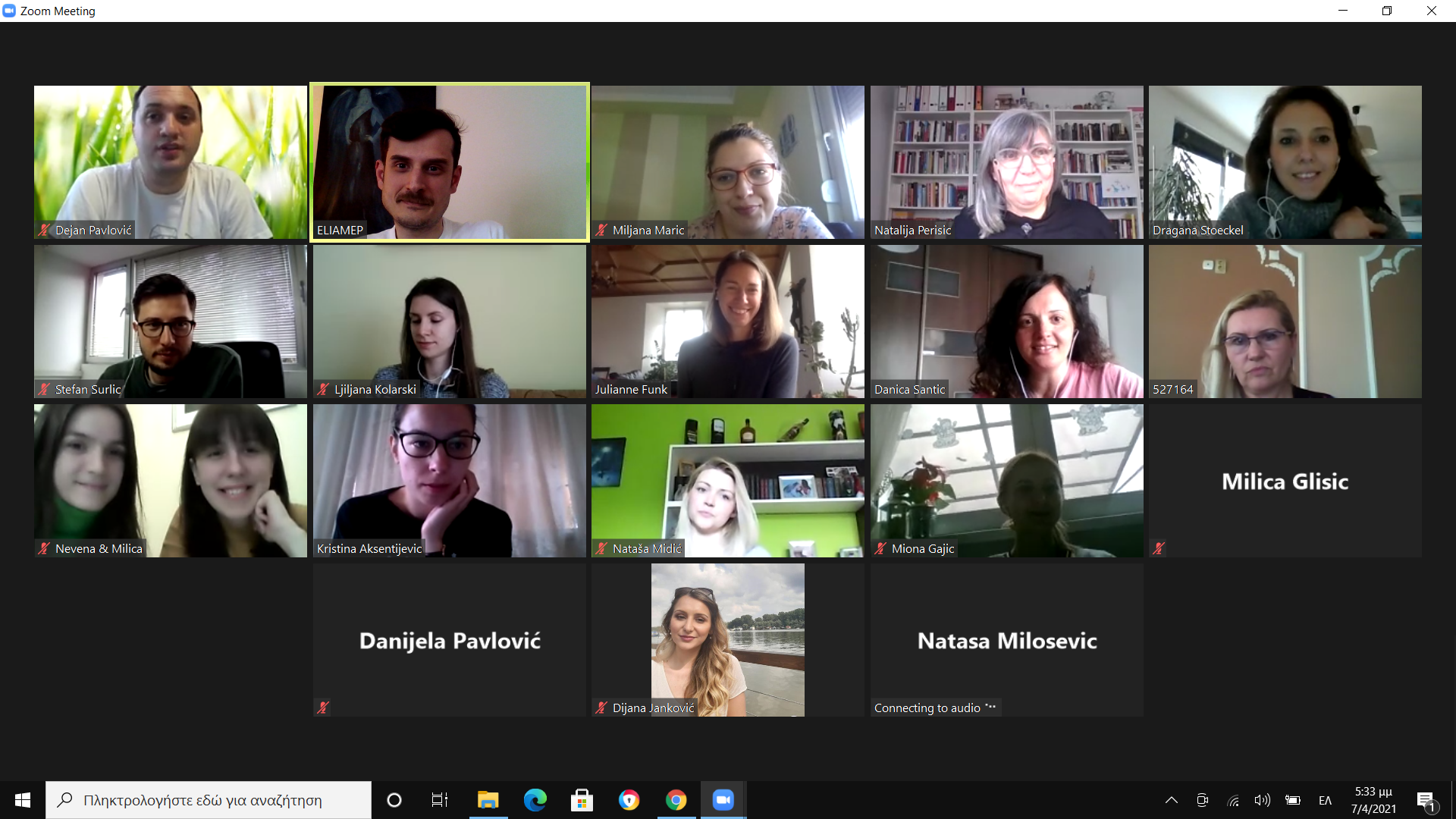
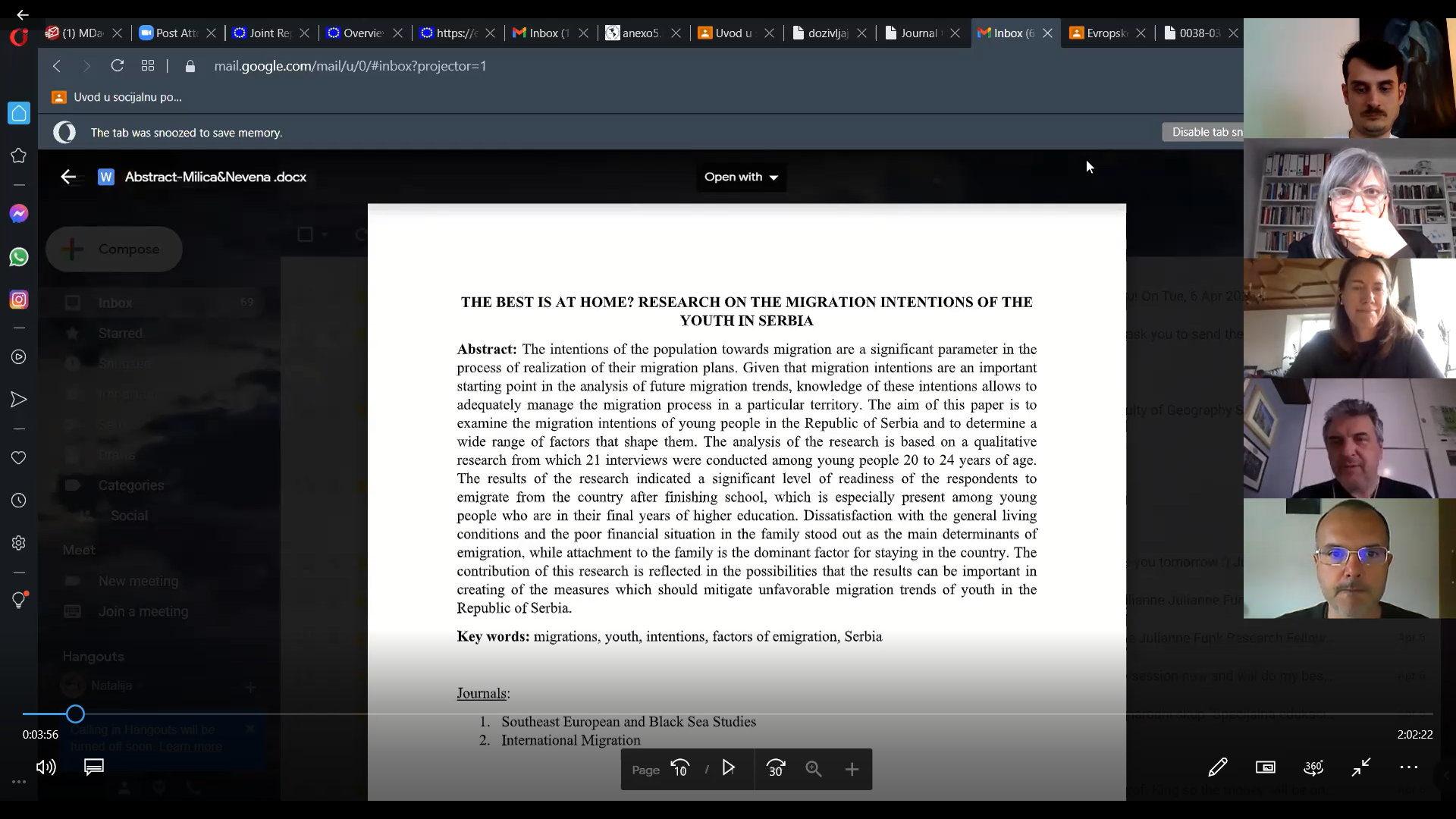
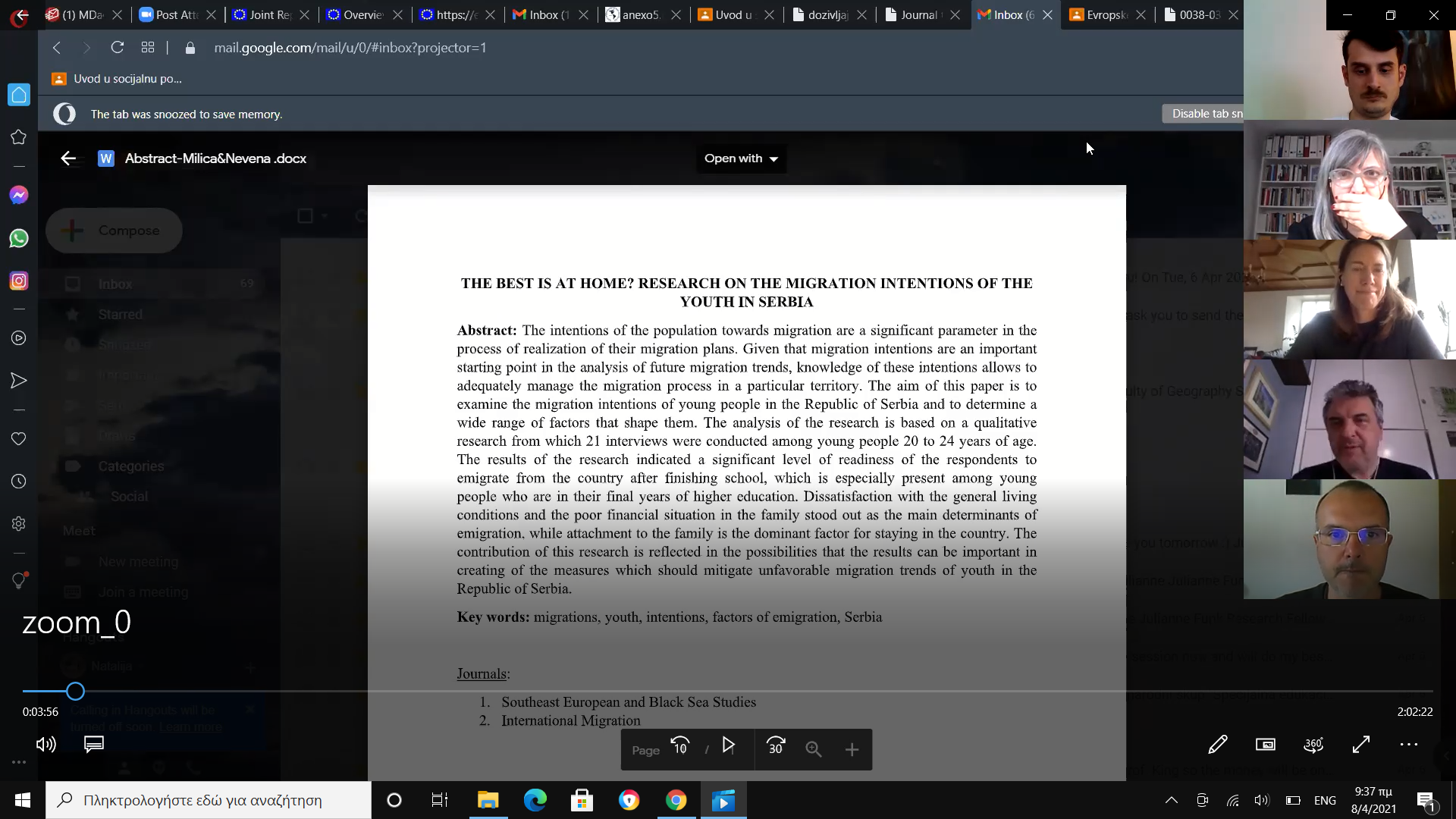
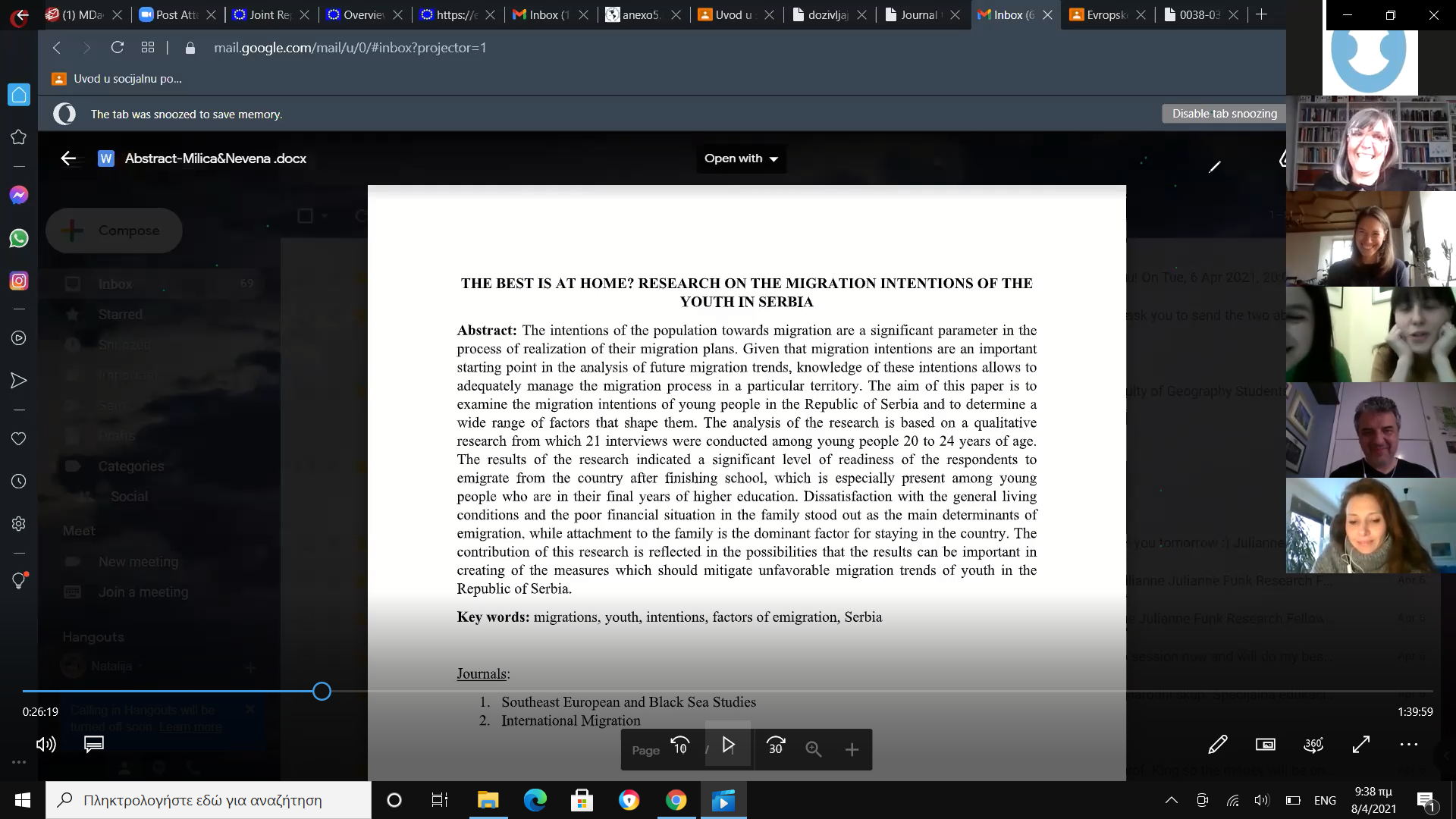
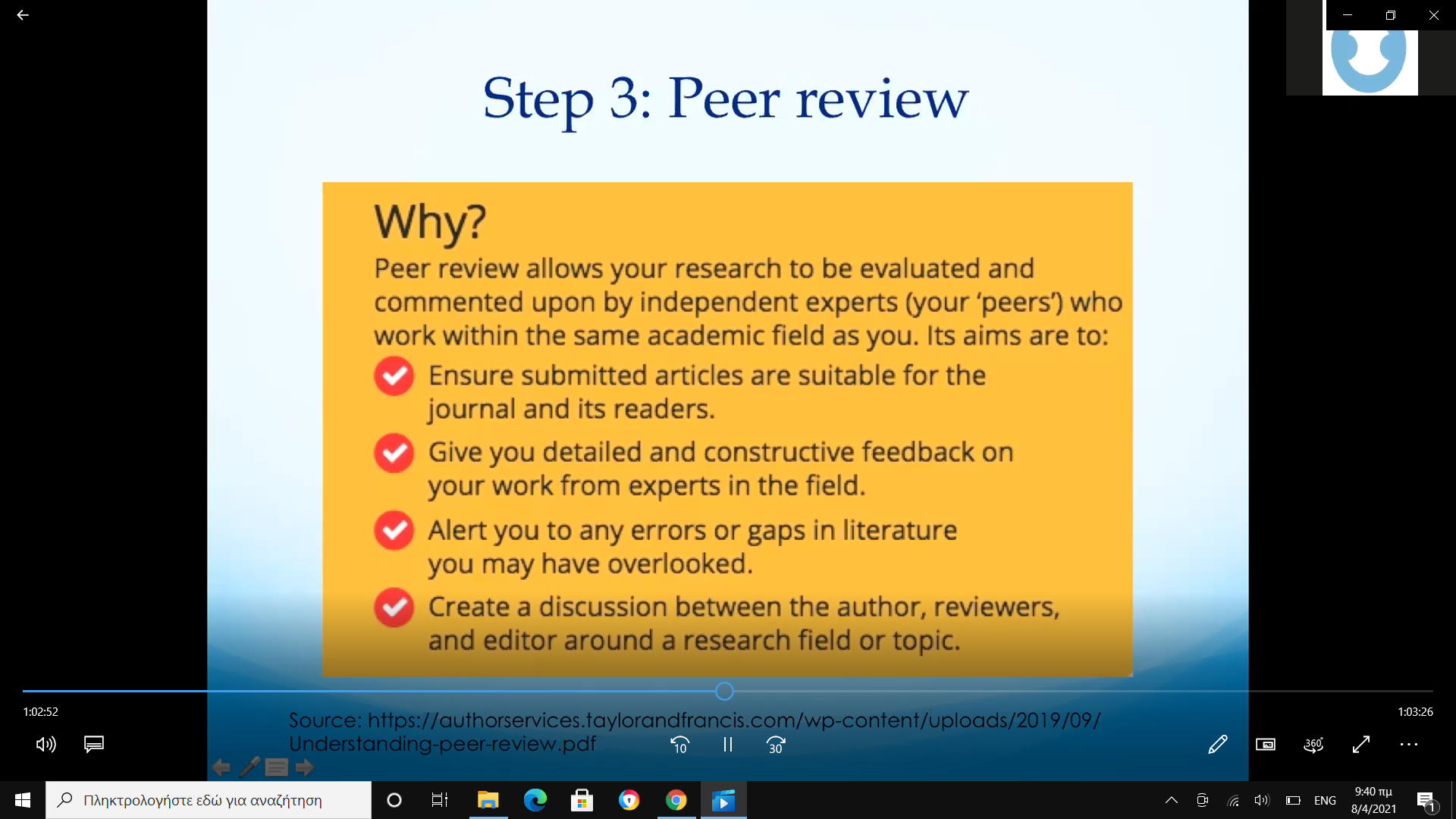
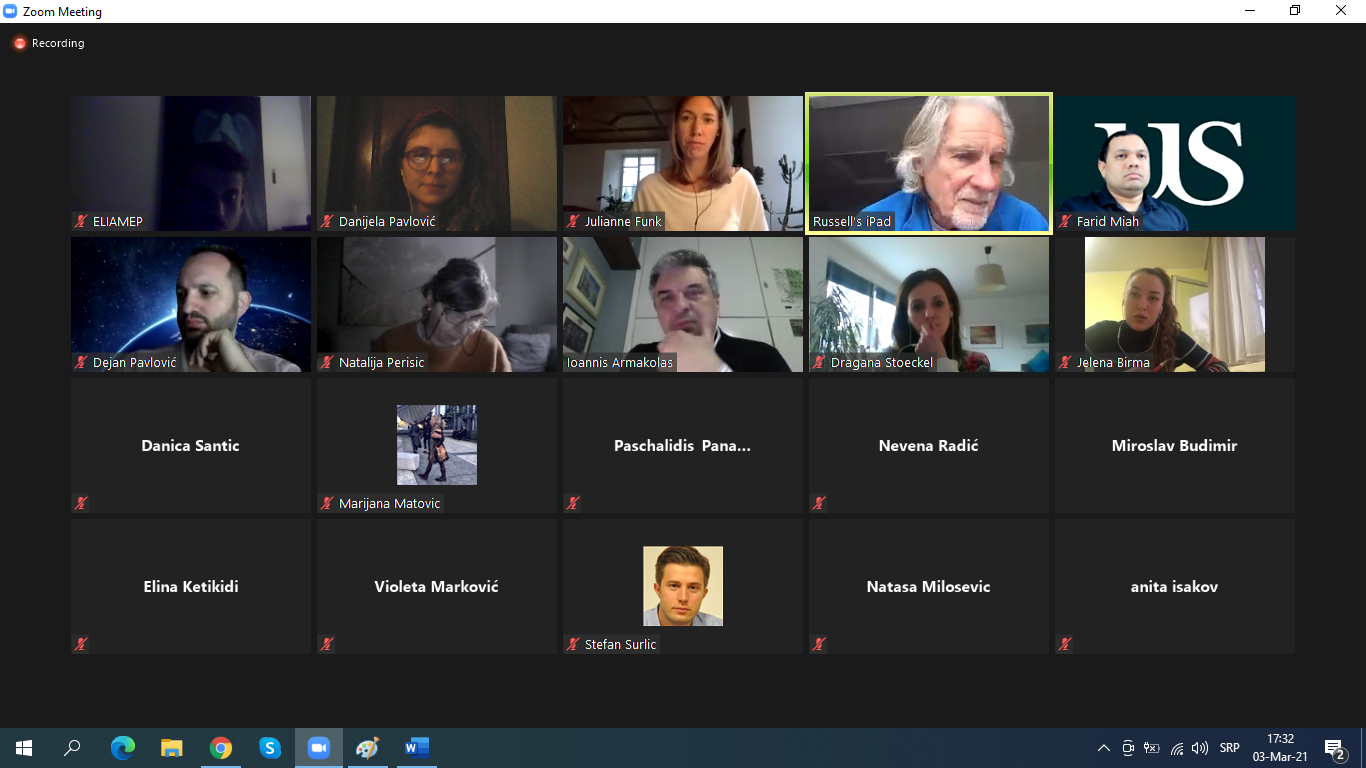
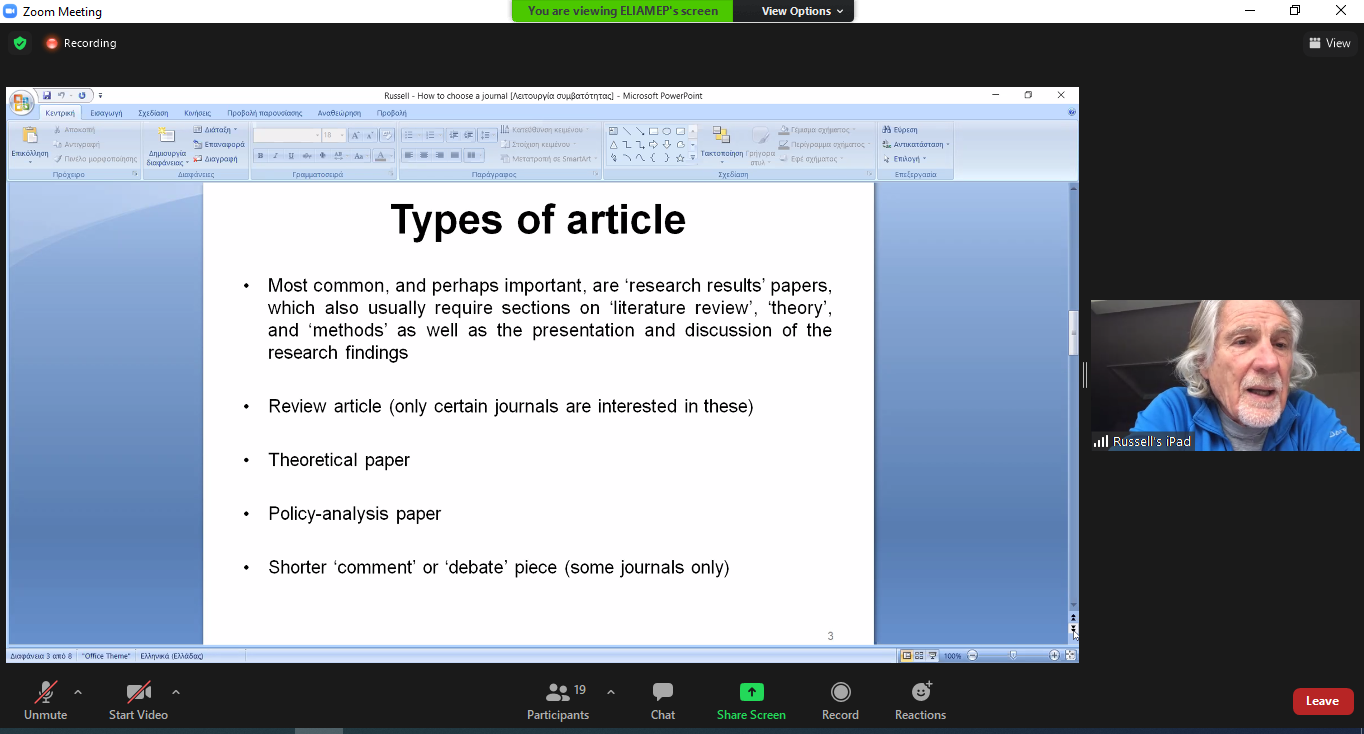
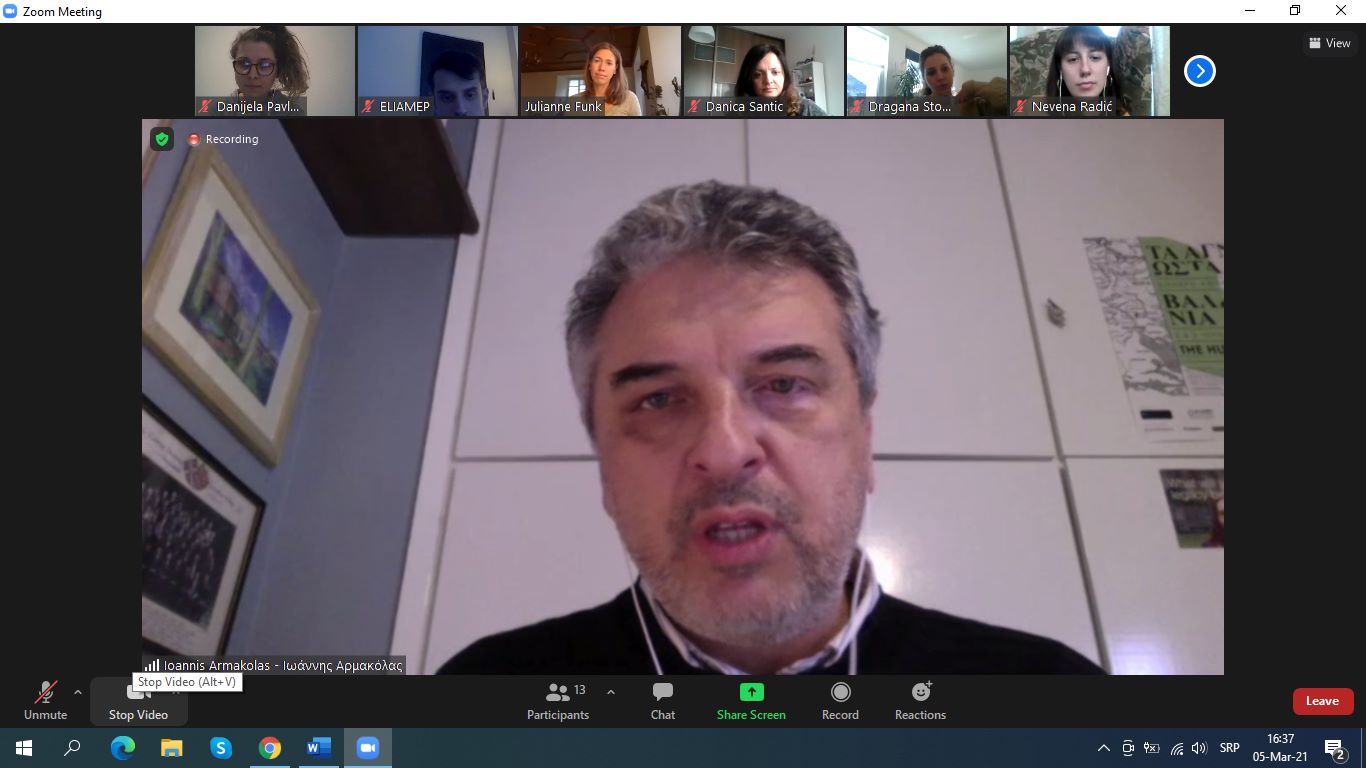
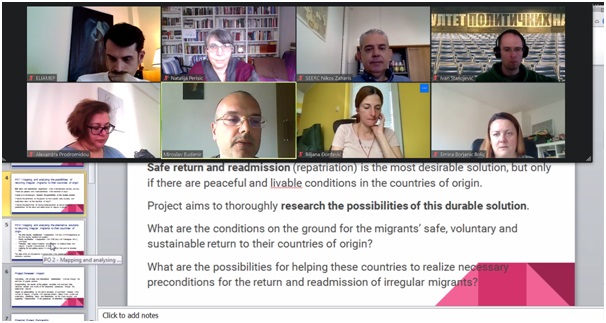
In March and April 2021 the MIGREC project held its first Publishing Seminar on the theme ‘What to expect: understanding the international academic publication process’. The seminar was led by ELIAMEP team members of MIGREC, Drs. Ioannis Armakolas and Julianne Funk, who are also editors of the journal Southeast European and Black Sea Studies (SEEBSS). The four sessions of the seminar were held online and attended mostly by University of Belgrade MA students, PhD candidates and professors, but also other MIGREC team members from ELIAMEP and SEERC. The goal of the seminar was to improve the understanding of the publication process for prominent international scientific journals.

The first and second sessions, on 3 and 5 March, focused on identifying the academic journal that best fits one research article. The first session featured a guest lecturer, Anthropology professor Russell King of the University of Sussex who shared his experience as the editor of the well-known migration journal JEMS. The second session expanded on this excellent foundation to discuss the topic from an area studies perspective, as provided by the Armakolas and Funk, editors of SEEBSS. Topics covered in these sessions included: choosing one’s audience, journal aims and scope that match one’s research, the importance of journal metrics and types of publishing options.

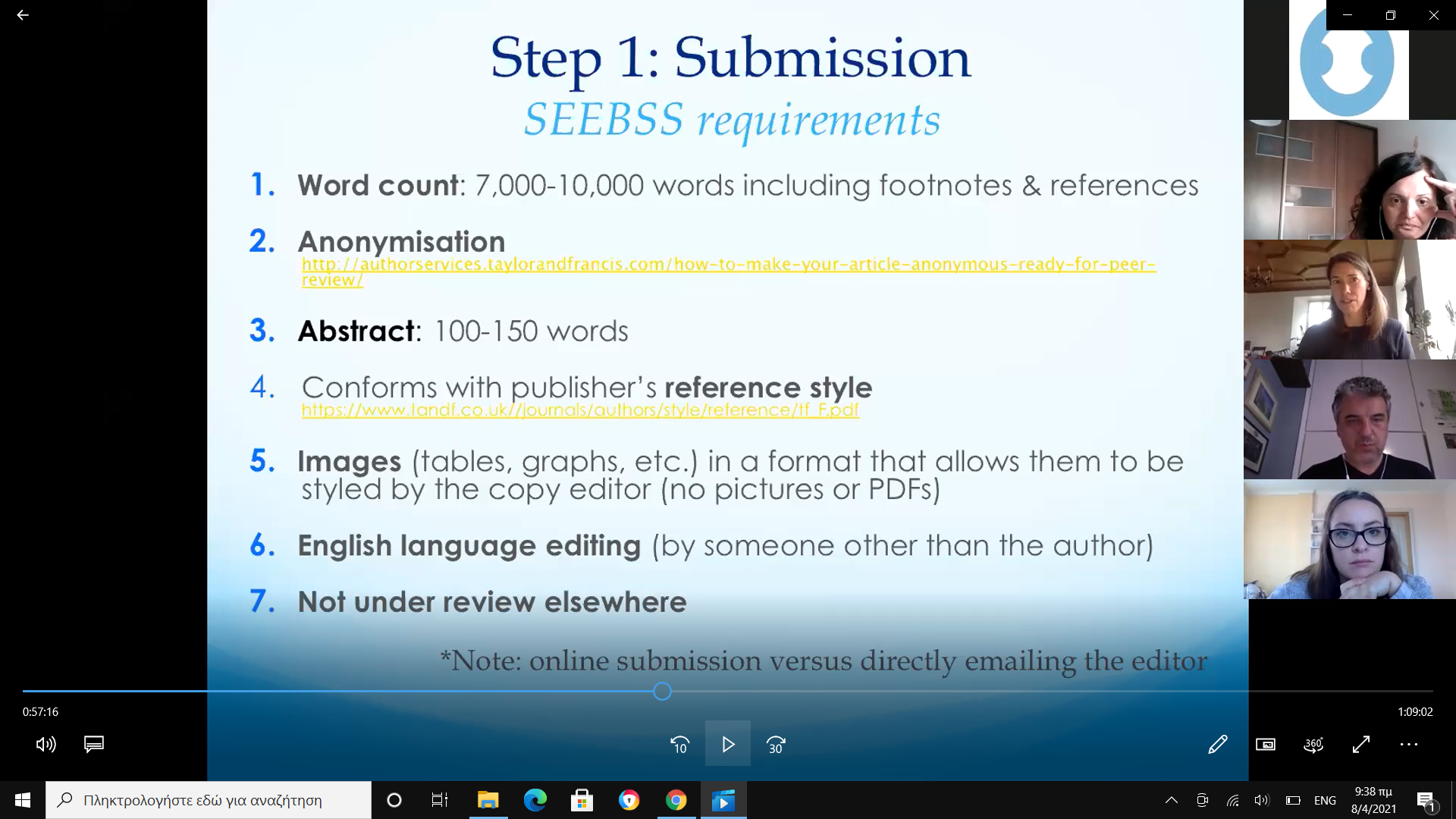
The third and fourth sessions of the seminar, on 31 March and 7 April, provided detailed information about preparing a manuscript to submit to an international journal and what happens to that manuscript while you are waiting, from the perspective of the editors of SEEBSS and other examples provided by participants. The goal of the third session was to give inside tips to students and scholars about crucial elements editors look for in a newly submitted manuscript and how to avoid desk rejection. The fourth session covered how to engage with international journals, including specific submission requirements and instructions for authors, online submission systems, English language copy-editing, and what to expect during the process of peer review towards publication. In both sessions we worked with the titles, abstracts and keywords of students participating, suggesting improvements.

The MIGREC team looks forward to the next Publishing Seminar, to be held hopefully in May / June 2021, ‘Publish or Perish. Marketing your research to reach an international audience’, which aims to grow participants’ capacities to produce more appealing research outputs for prominent international scientific journals.


MIGREC’s first Publishing Seminar a success Read More »
MIGREC’s Training workshop

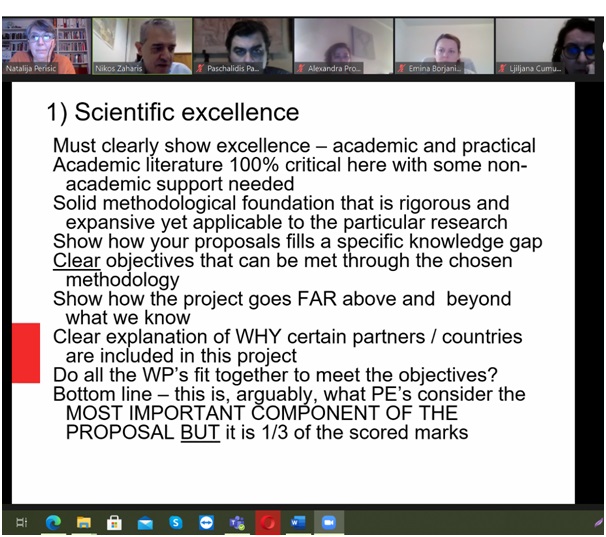
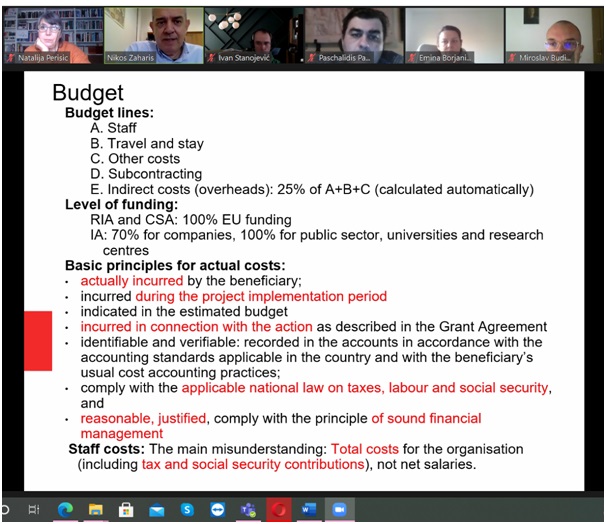
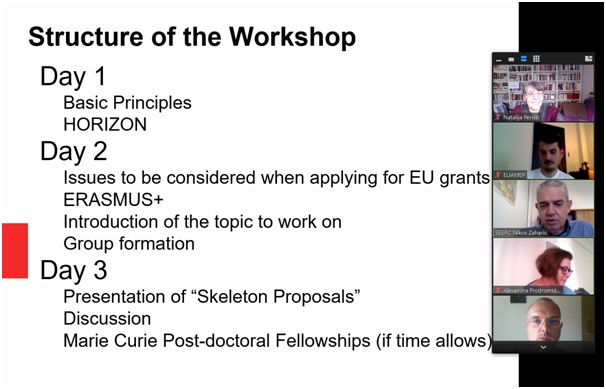
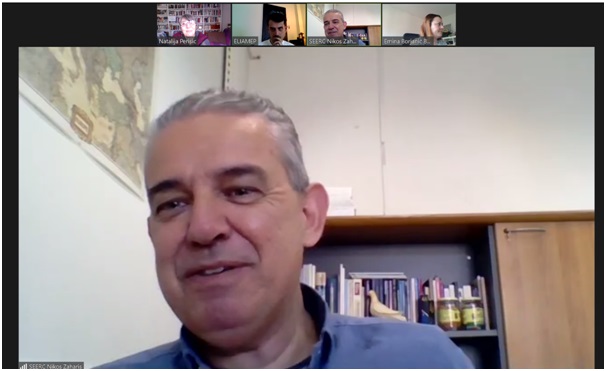
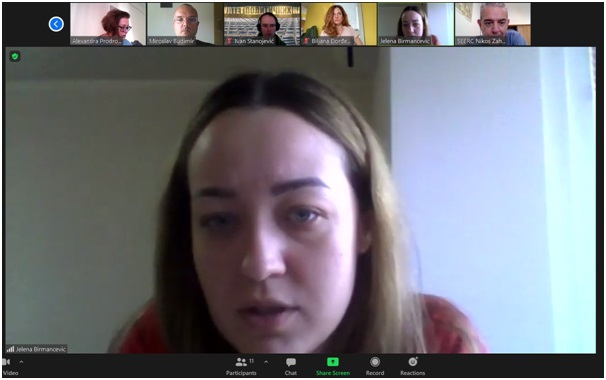
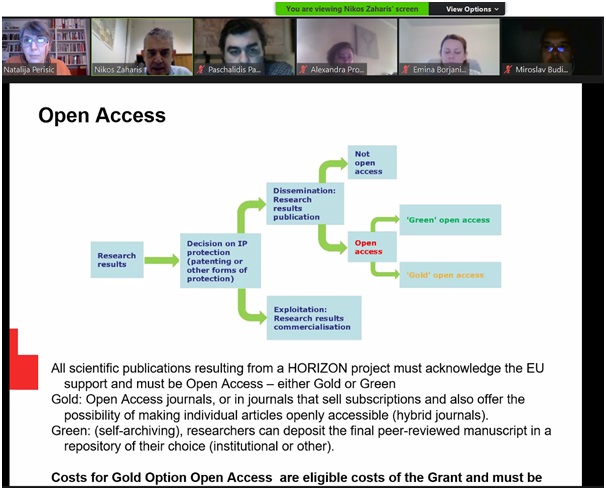
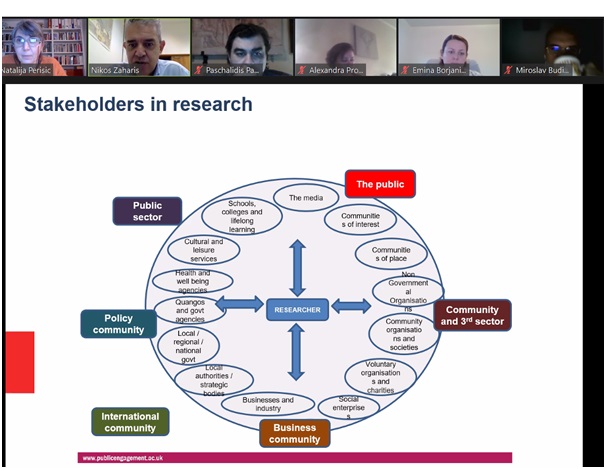
The First MIGREC “Training workshop in applying for external research funding with emphasis on HORIZON EUROPE” took place online during 3 days: March 22, 24 and 29, 2021. Research staff from FPN, GEF and other Faculties including PhD candidates plus researchers from ELIAMEP and SEERC participated in an intense workshop led by Nikos Zaharis, SEERC Director.

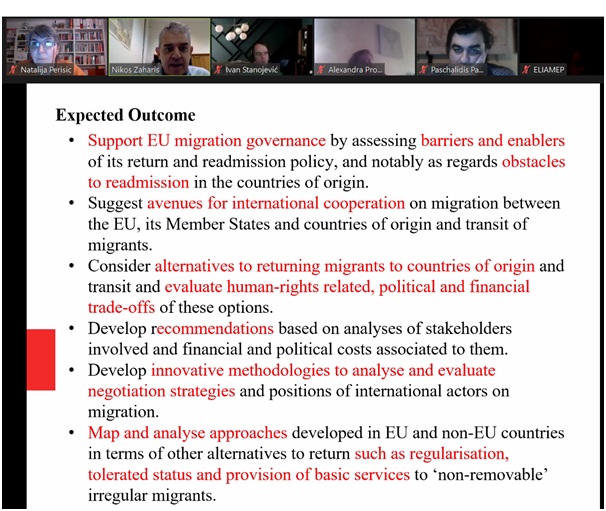
The workshop started with a definition and basic principles of externally funded research and went on to discuss in detail the aims and mechanisms of the main EU research funding programs H2020 and HORIZON EUROPE along with relevant aspects of ERASMUS+. Emphasis was given to research topics that are relevant to migration studies. As examples, two calls were examined in detail:

  • Mapping and overcoming integration challenges for migrant children (closed call; the workshop studied the resulting projects) and
  • Return and readmission of irregular migrants in the EU (future call)

The participants studied the second call and formed three groups that worked together on “Skeleton Proposals” which were presented and discussed the third day of the workshop. The “skeleton proposals” included an outline of the following items: i) Proposed progress beyond the state of the art, ii) Project Objectives, iii) Project Foreseen Impact, iv) Potential Project Partnership and v) Project Work-Plan.

Finally, the workshop’s speaker Nikos Zaharis presented in more details the upcoming call for the MSCA Post-doctoral fellowships, which is a prospect that should interest both young researchers (as potential post-doctoral fellows) and the Faculties of the University of Belgrade (as possible host organisations).


MIGREC’s Training workshop Read More »
MIGREC at the conference of the Demographic Association of Serbia

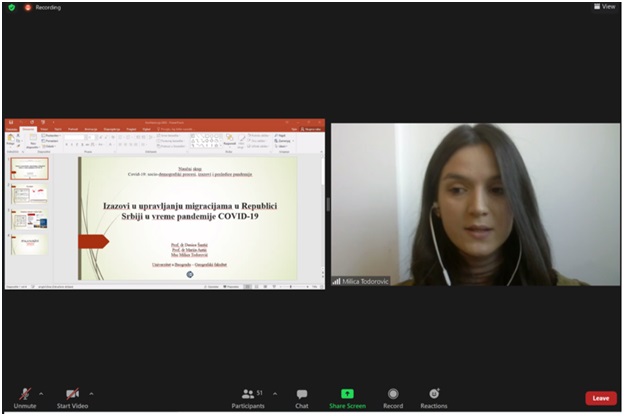
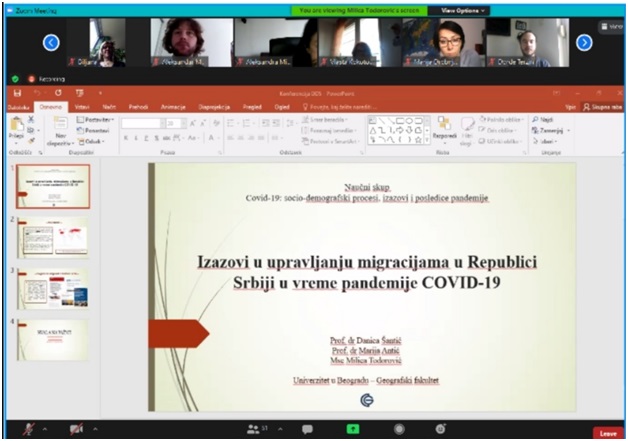
Members of the MIGREC team – Danica Šantić, Marija Antić and Milica Todorović – participated at the conference “COVID-19: socio-demographic processes, challenges and consequences of the pandemic” organized by the Demographic Association of Serbia and the Center for Demographic Research of the Institute of Social Sciences with presentation “Challenges in Migration Management in the Republic of Serbia during the COVID-19 pandemic”, on March 25, 2021.

The academic conference was devoted to analyses of effects and consequences of the COVID-19 pandemic on demographic, social and migration processes. More than 50 prominent researchers from the Republic of Serbia and other countries of the region who treat population topics from various aspects took part in the conference. Although long-term consequences of the pandemic for population, society and migration are still uncertain, the participants on this occasion exchanged the so-far obtained research results, opinions and attitudes in the actual pandemic context. The papers were organized in three sessions: mortality due to the corona virus pandemic, COVID-19 and population and social groups and COVID-19 – migration and labour market.

Prof. Danica Šantić, Prof. Marija Antić and Milica Todorović, MSc, presented their research results within the third session: COVID-19 – migration and labour market. Their research put accent on the challenges the Republic of Serbia faced with in management of return migration flows and irregular migration in the aftermath of introduced state of emergency. The authors pointed out that mass return migration flows in the Republic of Serbia in that period made a huge challenge for the state which policy moved between “don’t stay/don’t leave” discourses. On the other hand, it was stressed that irregular migrants during the state of emergency faced with particularly unfavorable circumstances having in mind the limitation of movement from the admission centres and high level of their stigmatization. The conclusion is that in this period the migration-related policies were carried out in accordance with the conditions of global health and economic crises, which the Republic of Serbia was not exempted from.


MIGREC at the conference of the Demographic Association of Serbia Read More »
MIGREC Project presented at the Twinning Project Days

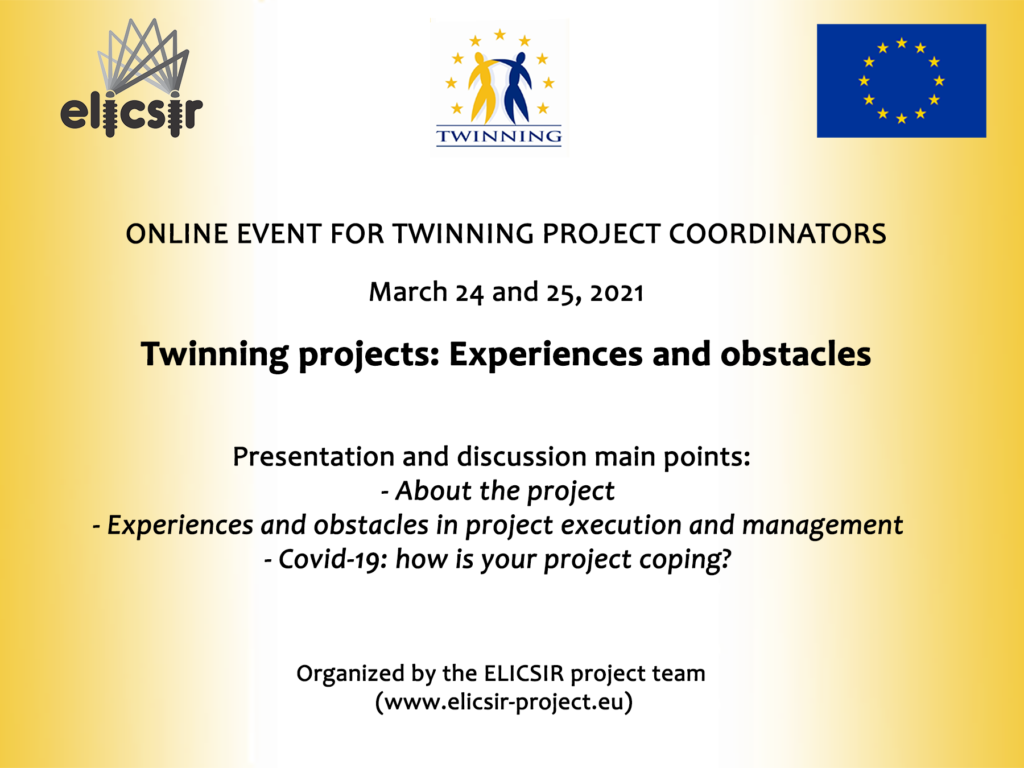
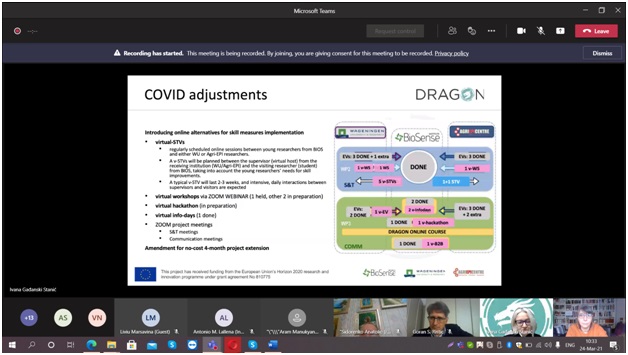
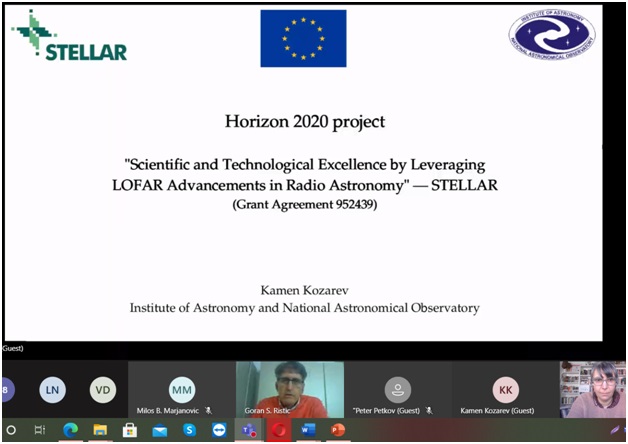
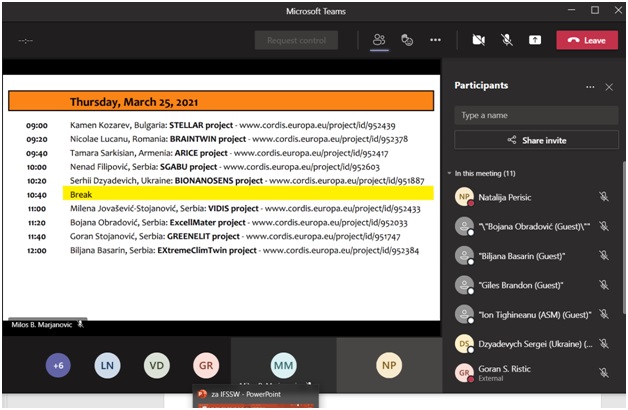
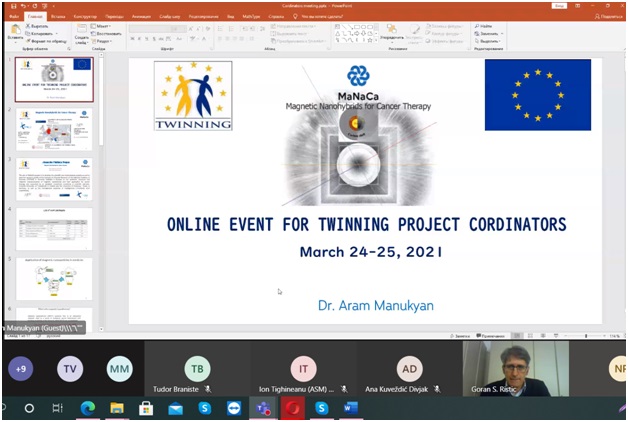
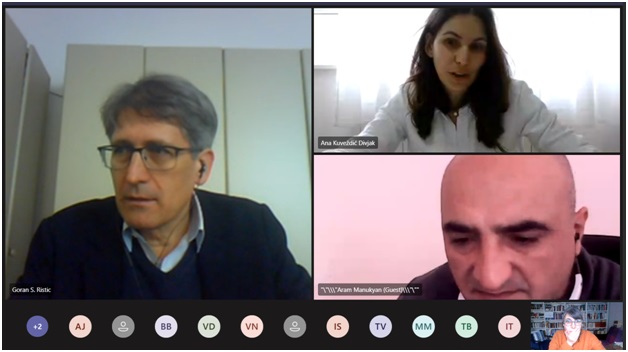
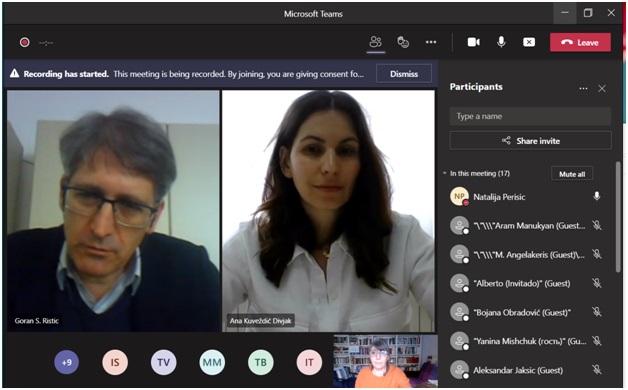
The Twinning Project Days were held at the MS Teams online platform on March 24 and 25, 2021. The Faculty of Electronic Engineering of the University of Niš – coordinator of the ELISCIR project – was the organizer.

Out of the need for connecting and networking and exchange of experiences in implementation of the Twinning projects, the coordinator of the ELICSIR project, Prof. Goran Ristić, organized presentations of nineteen ongoing Twinning projects funded within the EU Horizon2020 programme. Coordinators from seven European countries presented goals, work packages and impact of their respective projects. A particular segment of presentations was devoted to the adjustment of project activities to new circumstances due to the COVID-19 pandemic. Project coordinators exchanged extremely useful experiences on transfer of activities to online forms, redistribution of cost, introduction of new activities etc.

Prof. Natalija Perišić presented general and particular goals of the MIGREC project, the activities realized so far within the work packages and influence of COVID-19 on current and further activities. The record of presentation of the MIGREC project is available at the link https://youtu.be/Pf9nxtKfyN0.


MIGREC Project presented at the Twinning Project Days Read More »
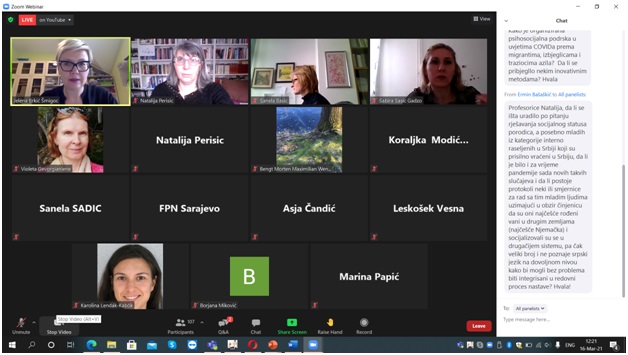
MIGREC online presentation at an academic conference in Sarajevo

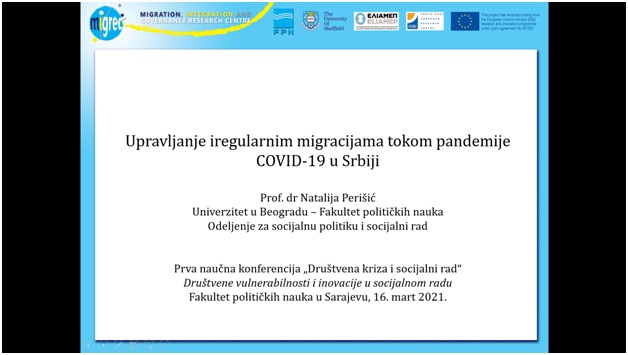
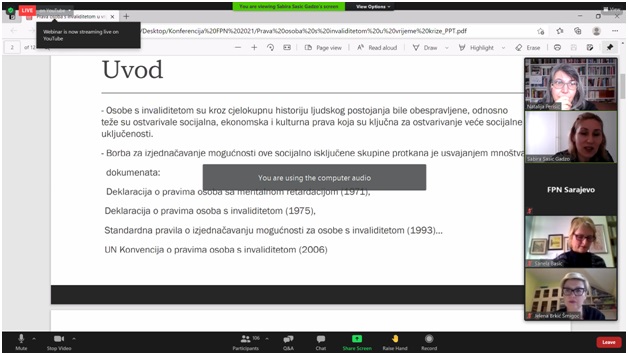
Member of the MIGREC team Natalija Perišić participated at the academic conference “Social Vulnerabilities and Innovation in Social Work” organized by the Faculty of Political Science of the University of Sarajevo, with online presentation “Irregular Migration Governance during the COVID-19 Pandemic in Serbia” on March 16, 2021.

The conference was aimed at contributing the re-creation of inclusive sociality for the post-crisis period, by launching a dialogue between academic and professional communities on possibilities for (self)critical re-description of professional paradigm on the platform advocated by the Global Agenda for Social Work and Social Development 2020-2030, with focus on welfare and wellbeing of all on the principles of social citizenship, human rights and social justice. The conference was envisaged as a place for presentations, discussion and critical reflection of innovative policies, programmes and approaches of professional social work in promoting, advocating and realization of inclusive, democratic, just and solidary society. The plenary session has been accompanied with four thematic panels.

Prof. Natalija Perišić’s presentation focused on the actions of the Government of the Republic of Serbia during the state of emergency proclaimed in March 2020, in the field of irregular migration. The adoption of the decision on limitation of movement of irregular migrants and asylum seekers as a consequence of the COVID-19 pandemic resulted in overcrowded capacities in the asylum and reception centres. In order to facilitate the situation, the Commissariat for Refugees and Migration of the Republic of Serbia increased accommodation capacities and took numerous urgent measures. However, the adjustment of other state institutions to new circumstances was extremely slow. This influenced aggravation of living conditions of irregular migrants and asylum seekers, particularly combined with limiting non-governmental sector to involve in provision of support and assistance. The presentation delivered by Prof. Natalija Perišić pointed to the needs for more careful planning of decisions and measures pertaining to irregular migration governance, in coordination with other policies important for irregular migrants and asylum seekers.


MIGREC online presentation at an academic conference in Sarajevo Read More »